Brand: BOLEX
Category: Camera
Document Type: Manual
Language: EN
Brand: BOLEX
Category: Camera
Document Type: Manual
Language: EN
Uploaded: Aug. 10, 2025, 12:37 a.m.
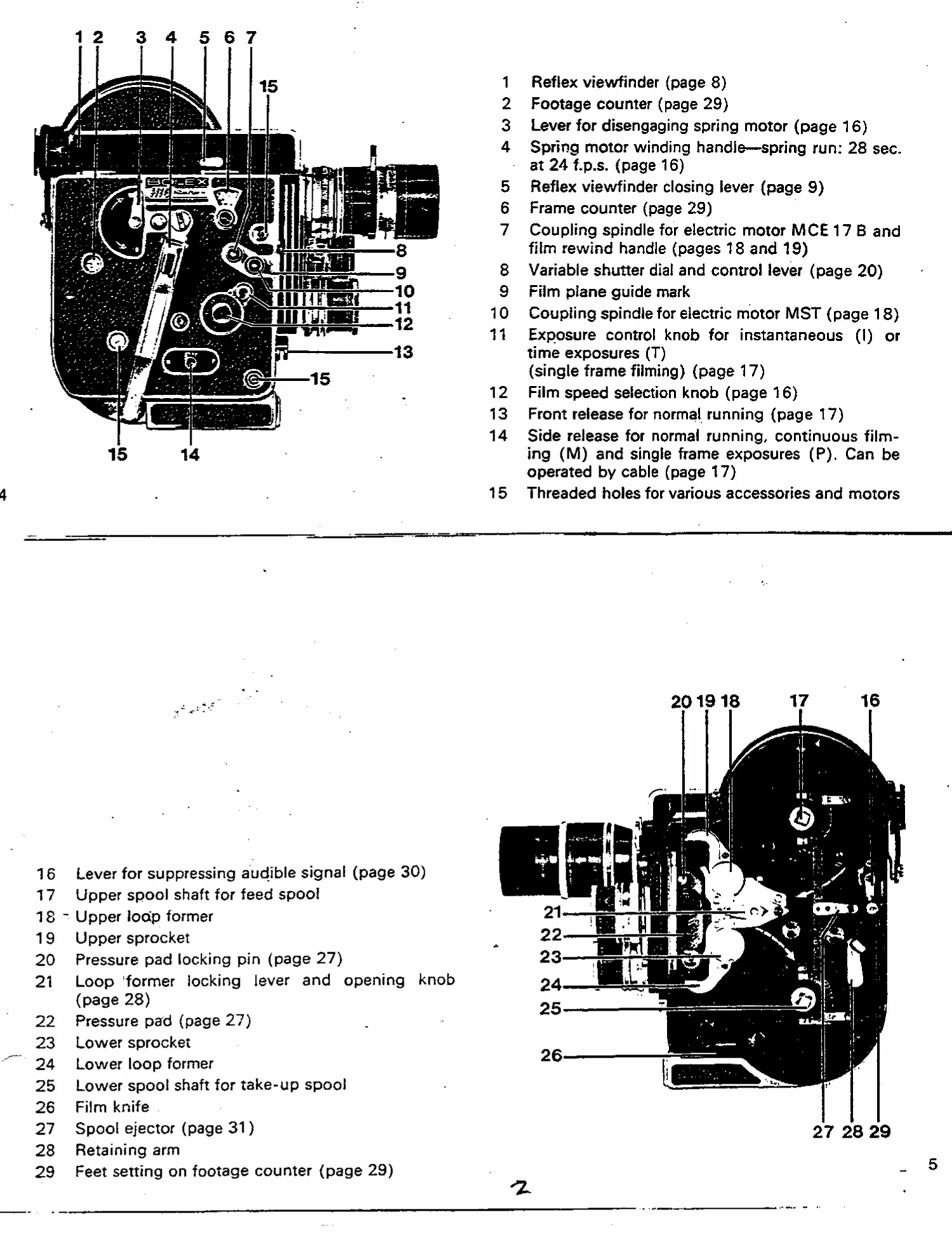
Move the side release to STOP and the motor disengaging lever to MOT. Lift the motor winding handle, which automatically engages with the spindle, and turn anti-clockwise. Wind the spring motor fully but without forcing it, then lower the handle and secure it on catch (a). Fully wound, the motor drives nearly 18 ft. of film, i.e. 28 seconds' filming time at the speed of 24 f.p.s. Make a habit of rewinding the motor after each take.
The camera has seven filming speeds: 12, 16, 18, 24, 32, 48 and 64 frames per second. To select the desired speed, turn the control knob (b) until the corresponding figure is opposite the red dot. When the film is projected at normal speed (18 or 24 f.p.s.), a lower filming speed will produce an accelerated motion effect while a higher filming speed will give a slow motion effect.
The H 16 Reflex camera can be used for normal, continuous or single-frame filming. These different operations are controlled by the side release. Normal filming is suitable for most general shots. Single frame filming: Push the side release to P. Instantaneous: turn the knob until the guide mark is in position I. Time exposures: guide mark in position T.
| Fault | Cause | Remedy |
|---|---|---|
| Film under-exposed, pictures reversed, general orange tint | Variable shutter left closed. | Film incorrectly loaded with dark side facing towards the lens. |
| Pictures too dark and flat | Under-exposure (too small a diaphragm opening for the filming speed, film sensitivity and shutter aperture). | Over-exposure (too wide a diaphragm opening for the filming speed, film sensitivity and shutter aperture). |
| Pictures too clear and washed-out | Inaccurate distance setting. | Inaccurate distance setting. |
| Blurred pictures | Camera unsteadiness or panning too rapidly. | Camera unsteadiness or panning too rapidly. |
| Jumpy pictures | Camera unsteadiness or panning too rapidly. | Camera unsteadiness or panning too rapidly. |
| Unnatural colouring | Using filters designed for black-and-white film when shooting in colour. | Too long a delay between exposure and development. Films poorly stored before or after exposure. |
| Dominant red-orange tint | Filming too early in the morning or too late in the evening. | Using tungsten lamps with a daylight type film or an under-powered lamp with "artificial light" film. |
| Dominant blue tint | Partly obscured pictures | Filming distant subjects at high altitudes or on water without the appropriate filter. Water scenes with strong reflections, filmed without polarizing filter. |
| Partly obscured pictures | An object, such as a finger or a long telephoto lens, in front of the taking lens. | Turret badly positioned. |
| Parallel scratches on the edge of the film | Dust or particles of emulsion in the film gate. | Camera badly loaded. |
| Fogged film | Direct light entering through the reflex viewfinder. | Careless loading or unloading of the camera so that sensitive film was accidently exposed to light. The filter-mount left out of its slot. |
| Film fogged at edges | Careless loading or unloading of the camera so that sensitive film was accidently exposed to light. The filter-mount left out of its slot. | Careless loading or unloading of the camera so that sensitive film was accidently exposed to light. The filter-mount left out of its slot. |
| Out-of-focus or distorted picture | Pressure pad incorrectly locked. | Pressure pad incorrectly locked. |