Brand: CASIO
Category: Digital Camera
Document Type:
Language: EN
Brand: CASIO
Category: Digital Camera
Document Type:
Language: EN
Uploaded: Aug. 9, 2025, 11:41 p.m.
| Symptom | Possible Cause | Action |
|---|---|---|
| Power does not turn on. |
1) The batteries are not oriented correctly. 2) The batteries are dead. 3) You are using the wrong type of AC adaptor. |
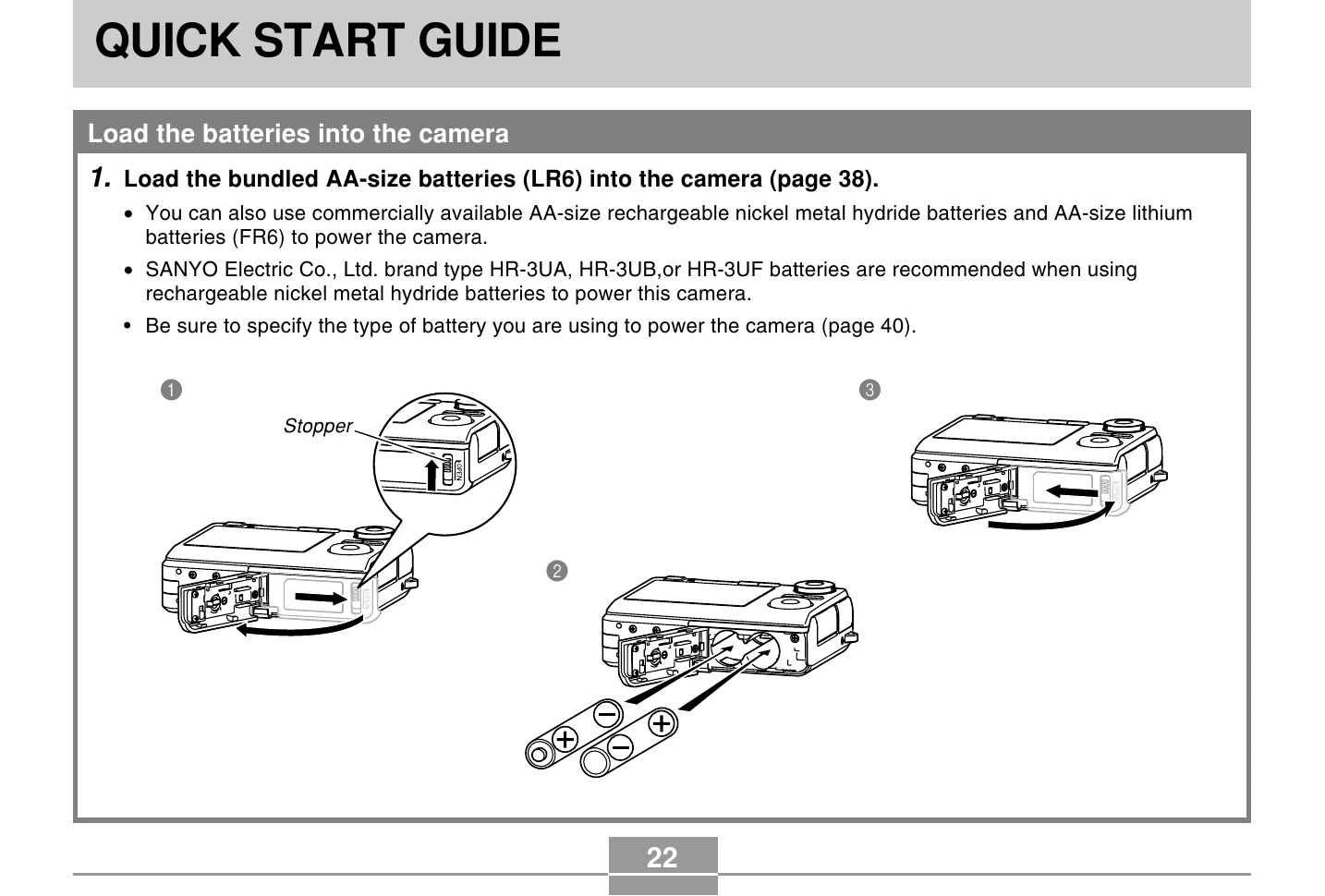
1) Orient the batteries correctly (page 38). 2) Replace the batteries (page 41). 3) Use only the type of AC adaptor (AD-C30) specified for this camera. |
| Camera suddenly powers down. |
1) Auto Power Off activated (page 48). 2) The batteries are dead. |
1) Turn power back on. 2) Replace the batteries (page 41). |
| Image is not recorded when the shutter button is pressed. |
1) The camera is in the PLAY mode. 2) Flash unit is being charged. 3) Memory is full. |
1) Press [■] (REC) to enter the REC mode. 2) Wait until the flash unit finishes charging. 3) Transfer files you want to keep to your computer and then delete files from image memory, or use a different memory card. |
| Auto Focus does not focus properly. |
1) The lens is dirty. 2) The subject is not located in the center of the focus frame when you compose the image. 3) The subject you are shooting is a type that is not compatible with Auto Focus operation (page 63). 4) You are moving the camera. |
1) Clean the lens. 2) Make sure the subject is centered in the focus frame when composing the image. 3) Use manual focus (page 85). 4) Mount the camera on a tripod. |
| The subject is out of focus in the recorded image. | The image is not focused properly. | When composing the image, make sure the subject on which you want to focus is located inside the focus frame. |
| Scenery shots are out of focus. |
1) The image is not focused properly. 2) The wrong focus mode is selected. 3) The wrong BEST SHOT scene is selected. |
1) When composing the image, make sure the subject on which you want to focus is located inside the focus frame (page 58). 2) Change the focus mode to "AF" (Auto Focus, page 80) or "∞" (infinity, page 84). 3) Change the BEST SHOT scene to “Scenery” (page 98). |
| The flash does not fire. |
1) "■" (flash off) is selected as the flash mode. 2) The batteries are dead. 3) A scene that selects "■" (flash off) as the flash mode is selected in the BEST SHOT mode. |
1) Select a different flash mode (page 69). 2) Replace the batteries (page 41). 3) Select a different flash mode (page 69) or BEST SHOT scene (page 98). |
| Camera powers down during self-timer countdown. | The batteries are dead. | Replace the batteries (page 41). |
| Monitor screen image is out of focus. |
1) You are using the Manual Focus mode (MF) and have not focused the image. 2) You are trying to use the Macro mode ⋀ when shooting a scenery or portrait shot. 3) You are trying to use the Auto Focus mode (AF) or the Infinity mode (∞) when shooting a close-up shot. |
1) Focus the image (page 85). 2) Use the Auto Focus mode (AF) for scenery and portrait shots. 3) Use the Macro mode ⋀ for close-ups. |
| Recorded images are not saved in memory. |
1) Camera powers down before the save operation is complete. 2) Removing the memory card before the save operation is complete. |
1) When the battery indicator shows "■", replace the batteries as soon as possible (page 41). 2) Do not remove the memory card before the save operation is complete. |
| Though available lighting is bright, the faces of human subjects appear dark. | Not enough light is reaching the subjects. |
• Change the flash mode setting to "■" (flash on) for daylight synchro flash (page 69). • Increase the EV shift value (page 87). |
| Subjects are too dark when recording images on a seashore or at a ski area. | Sunlight reflected by water, sand, or snow, can cause underexposure of images. |
• Change the flash mode setting to "■" (flash on) for daylight synchro flash (page 69). • Increase the EV shift value (page 87). |
| Vertical lines on the monitor screen. | Recording a very brightly lit subject can cause a vertical band to appear in the monitor screen image. | This is a CCD phenomenon known as “vertical smear”, and does not indicate malfunction of the camera. Note that vertical smear is not recorded with the image in the case of a snapshot, but it is recorded in the case of a movie. |
| Out of focus images. | The subject is outside the shooting range of the camera. | Record within the allowable shooting range. |
| Digital noise in images. | Sensitivity is increased automatically for dark subjects. Greater sensitivity increases the chance of digital noise. | Use a light or some other means to illuminate the subject. |
| Color of the playback image is different from the image on the monitor screen during recording. | Sunlight or light from another source is shining directly into the lens during recording. | Position the camera so sunlight does not shine directly into the lens. |
| Images are not displayed. | A memory card with non-DCF images recorded with another camera is loaded in the camera. | This camera cannot display non-DCF images recorded onto a memory card using another digital camera. |
| All buttons and switches are disabled. | Circuit problem caused by electrostatic charge, impact, etc. while the camera was connected to another device. | Remove the batteries from the camera, reinsert them, and then try again. |
| Monitor screen is off. | USB communication is in progress. | After confirming that the computer is not accessing camera memory, disconnect the USB cable. |
| Cannot transfer files over a USB connection. |
1) USB cable is not connected securely. 2) USB driver is not installed. 3) Camera is turned off. |
1) Check all connections. 2) Install the USB driver on your computer (page 193). 3) Turn on the camera. |