Brand: GE
Category: Other
Document Type: Manual
Language: EN
Brand: GE
Category: Other
Document Type: Manual
Language: EN
Uploaded: Nov. 21, 2025, 7:12 p.m.
Manual Publish Date: 2000-06-01
GE will replace defective parts for one year, including free labor and in-home service; glass cooktop and radiant surface units have extended coverage.
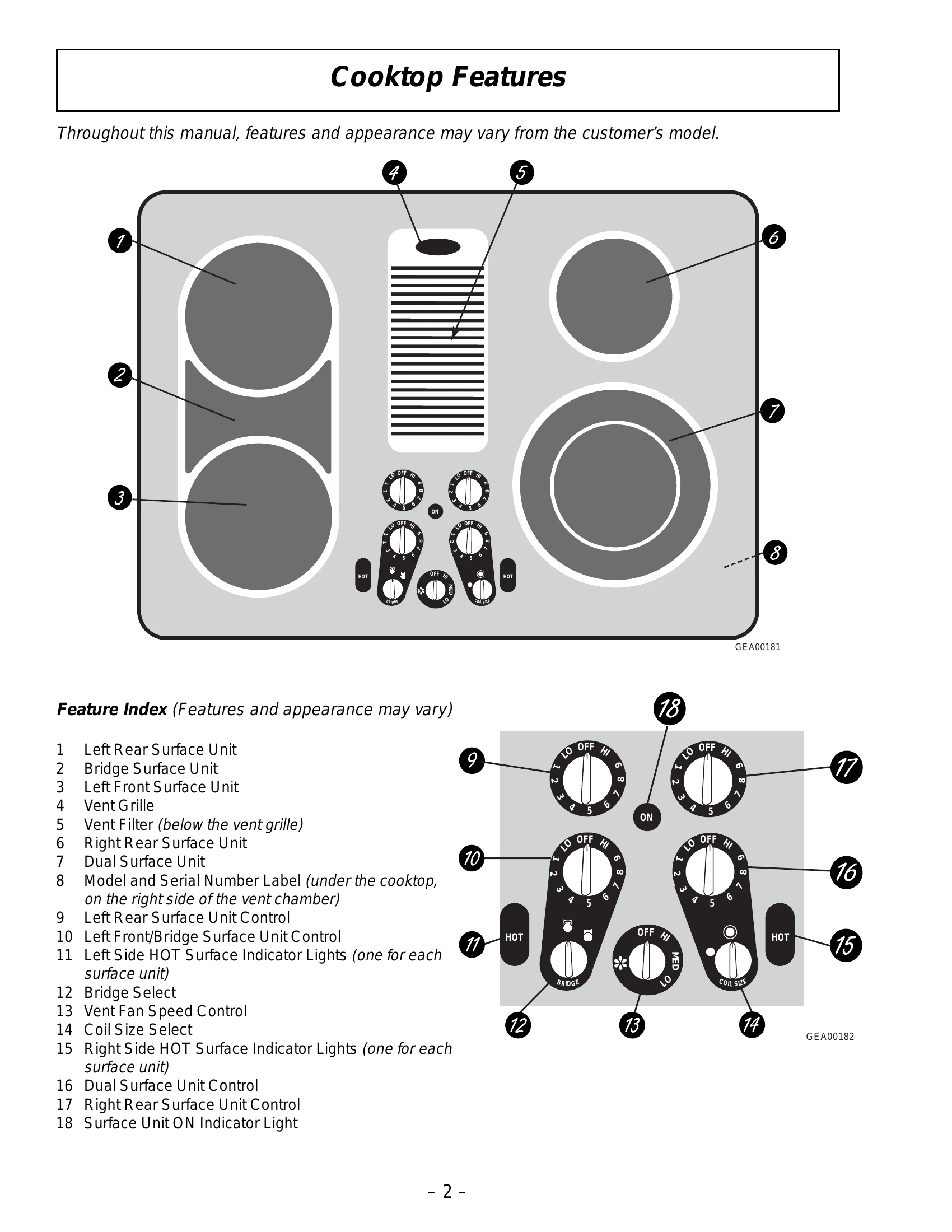
Radiant Surface Units: Set between LO and HI for unlimited heat settings. Units cycle on/off to maintain temperature. ON indicator light glows when any unit is on. HOT indicator lights glow when elements are on and remain on until cooled to approx. 150°F.
Dual Surface Unit: Use the COIL SIZE knob to select 9" (clockwise to 12 o'clock) or 6" (counterclockwise to 10 o'clock) heating area. Push control knob in and turn to desired setting.
Bridge Surface Unit: Knob at 12 o'clock controls left front unit only. Knob at 1 o'clock controls left front unit and bridge area.
Temperature Limiter: Protects glass cooktop from overheating by cycling units off if pan boils dry, is not flat, is off-center, or no pan is present.
Vent System: Turn vent fan speed control knob to HI, MED, or LO.
| Problem | Possible Causes | What to Do |
|---|---|---|
| Surface units will not maintain a rolling boil or cooking is not fast enough. | Improper cookware being used. | Use pans that are absolutely flat and match the diameter of the surface unit selected. |
| Surface units do not work properly. | A fuse in the home may be blown or the circuit breaker tripped. | Replace the fuse or reset the circuit breaker. |
| Cooktop controls improperly set. | Check to see the correct control is set for the surface unit being used. | |
| Faulty surface unit control switch. | Check continuity of switch and replace if defective. | |
| Faulty element. | Check continuity of element and replace if defective. | |
| Tiny scratches (may appear as cracks) or abrasions on radiant cooktop glass surface. | Incorrect cleaning methods being used. | Use recommended cleaning procedure. |
| Cookware with rough bottoms being used or coarse particles (salt or sand) were between the cookware and the surface of the cooktop. | Be sure cookware bottoms and cookware are clean before use. Use cookware with smooth bottoms. Tiny scratches are not removable, but will become less visible in time as a result of cleaning. | |
| Cookware has been slid across the cooktop surface. | See the Care and Cleaning section. | |
| Areas of discoloration on the cooktop. | Improper cookware being used. | Marks from aluminum and copper pans as well as mineral deposits from water or food can be removed with the cleaning cream. |
| Hot surface on a model with a white glass cooktop. | This is normal. The surface may appear discolored when it is hot. This is temporary and will disappear as the glass cools. | |
| Hot sugar mixtures or plastic melted to the surface. | Hot cooktop came into contact with these substances. | See the Care and Cleaning section. |
| Frequent cycling off and on of surface units. | Improper cookware being used. | Use only flat cookware to minimize cycling. |
| Cooktop feels hot. | Improper cookware being used. | The glass cooktop surface may seem hotter than the consumer is used to. This is normal. Use the pans which are absolutely flat. |
| Using the vent will help keep the cooktop cooler. | ||
| Foods cook slowly. | Improper cookware being used. | Pan bottoms should be flat, fairly heavy weight, and the same diameter as the surface unit selected. |
| Metal marks (may appear as cracks). | Incorrect cleaning methods being used. | Use recommended cleaning procedures. |
| Cookware has been slid across the cooktop surface. | See the Care and Cleaning section. | |
| Dark streaks or specks. | Improper cookware being used. | See the Care and Cleaning section. |
| Control knob will not turn. | Cooktop controls improperly set. | When the knob is in the OFF position, it must be pushed in before it can be turned. When the knob is in any other position, it can be turned without being pushed in. |
| Poor venting. | Clogged filter. | Clean filter per instructions. |
| House too airtight. | Open a window slightly to provide fresh air source. | |
| Wall cap obstructed. | Remove blockage from exterior wall cap. | |
| Wall cap damper door stuck. | Check exterior wall cap damper door for free movement or obstruction. | |
| Duct length exceeds recommended 100 equivalent ft maximum. | Have homeowner reduce number of elbows to simplify duct run. | |
| Faulty blower switch. | Check continuity of switch and replace if defective. | |
| Faulty blower motor. | Check capacitor. | |
| Check continuity of blower motor and replace blower assembly if defective. | ||
| One corner of the cooktop is not against the countertop. | Follow procedure in Cooktop Installation section. |