Brand: HP
Category: Computer
Document Type: Manual
Language: EN
Brand: HP
Category: Computer
Document Type: Manual
Language: EN
Uploaded: Nov. 21, 2025, 6:36 p.m.
Manual Publish Date: 2021-03-01
The only warranties for HP products and services are set forth in the express warranty statements.
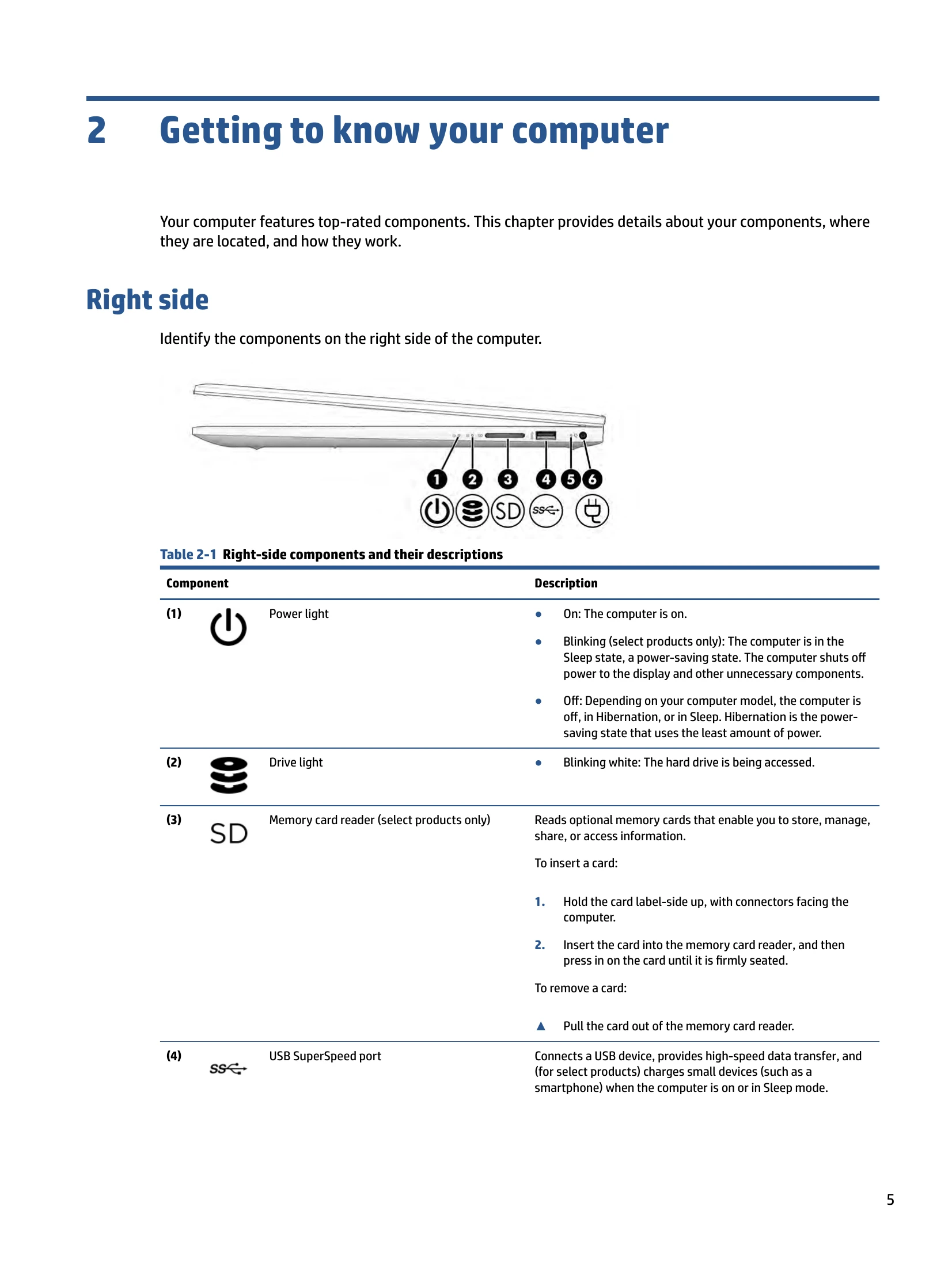
| Component | Description |
|---|---|
| (1) Power light | On: The computer is on. Blinking (select products only): The computer is in the Sleep state, a power-saving state. The computer shuts off power to the display and other unnecessary components. Off: Depending on your computer model, the computer is off, in Hibernation, or in Sleep. Hibernation is the power-saving state that uses the least amount of power. |
| (2) Drive light | Blinking white: The hard drive is being accessed. |
| (3) Memory card reader (select products only) | Reads optional memory cards that enable you to store, manage, share, or access information. |
| (4) USB SuperSpeed port | Connects a USB device, provides high-speed data transfer, and (for select products) charges small devices (such as a smartphone) when the computer is on or in Sleep mode. |
| (5) AC adapter and battery light | White: The AC adapter is connected and the battery is fully charged. Amber: The AC adapter is connected and the battery is charging. Blinking amber: The AC adapter is disconnected and the battery has reached a low battery level. Off: The battery is not charging. |
| (6) Power connector | Connects an AC adapter. |
| (1) USB SuperSpeed port | Connects a USB device, provides high-speed data transfer, and (for select products) charges small devices (such as a smartphone) when the computer is on or in Sleep mode. |
| (2) HDMI port | Connects an optional video or audio device, such as a high-definition television, any compatible digital or audio component, or a high-speed High-Definition Multimedia Interface (HDMI) device. |
| (3) USB Type-C® SuperSpeed port | Connects a USB device, provides high-speed data transfer, and (for select products) charges small devices (such as a smartphone) when the computer is on or in Sleep mode. |
| (4) Audio-out (headphone)/Audio-in (microphone) combo jack | Connects optional powered stereo speakers, headphones, earbuds, a headset, or a television audio cable. Also connects an optional headset microphone. This jack does not support optional standalone microphones. |
| (1) WLAN antennas* | Send and receive wireless signals to communicate with wireless local area networks (WLANs). |
| (2) Internal microphones (2) | Record sound. |
| (3) Camera light | On: The camera is in use. |
| (4) Camera | Allows you to video chat, record video, and record still images. Some cameras also allow a facial recognition logon to Windows, instead of a password logon. |
| (1) Caps lock light | On: Caps lock is on, which switches the key input to all capital letters. |
| (2) Mute light | On: Computer sound is off. Off: Computer sound is on. |
| (3) Power light | On: The computer is on. Blinking (select products only): The computer is in the Sleep state, a power-saving state. The computer shuts off power to the display and other unnecessary components. Off: Depending on your computer model, the computer is off, in Hibernation, or in Sleep. Hibernation is the power-saving state that uses the least amount of power. |
| (1) Speakers (2) | Produce sound. |
| (2) Power button | When the computer is off, press the button briefly to turn on the computer. When the computer is on, press the button briefly to initiate Sleep. When the computer is in the Sleep state, press the button briefly to exit Sleep (select products only). When the computer is in Hibernation, press the button briefly to exit Hibernation. |
| (3) Fingerprint reader (select products only) | Allows a fingerprint logon to Windows, instead of a password logon. |
| (1) esc key | Displays system information when pressed in combination with the fn key. |
| (2) fn key | Executes specific functions when pressed in combination with another key. |
| (3) Windows key | Opens the Start menu. |
| (4) Action keys | Execute frequently used system functions as defined by the icon symbols on f1 through f12 function keys. |
| (5) Power button | When the computer is off, press the button briefly to turn on the computer. When the computer is on, press the button briefly to initiate Sleep. |
| (6) num lk key | Alternates between the navigational and numeric functions on the integrated numeric keypad. |
| (7) Integrated numeric keypad | A separate keypad to the right of the alphabet keyboard. When num lock is pressed, the keypad can be used like an external numeric keypad. |
| Vent | Enables airflow to cool internal components. |