Brand: KENWOOD
Category: Other
Document Type: Manual
Language: EN
Brand: KENWOOD
Category: Other
Document Type: Manual
Language: EN
Uploaded: Nov. 21, 2025, 7:53 p.m.
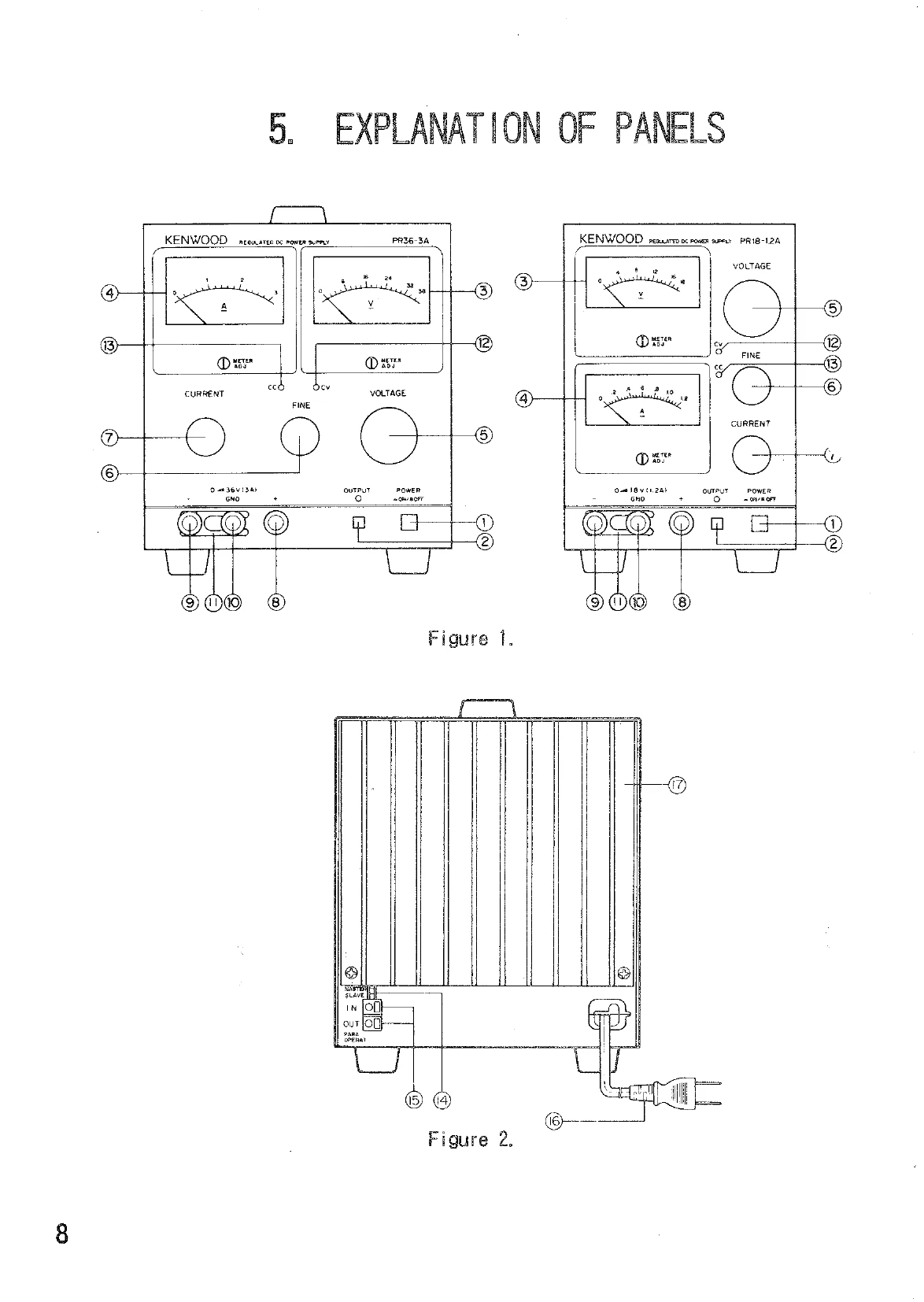
Stand-alone Operation: Ensure the MASTER/SLAVE switch is set to MASTER. Operate the power supply using the panel switches as needed. The POWER switch controls the unit's on/off state, and the OUTPUT switch controls the output on/off. Use the VOLTAGE COARSE and FINE knobs to adjust the output voltage and the CURRENT knob to set the limiting current value in constant current mode. The voltmeter and ammeter display the output voltage and current respectively. The CV LED indicates constant-voltage operation, and the CC LED indicates constant-current operation.
Serial Connection: Connect two or more units in series to increase output voltage. The total output voltage is the sum of individual unit voltages. Ensure the voltage to chassis GND does not exceed the ground proof voltage. Refer to Figure 3 and 4 for connection details.
Parallel Operation (Master-Slave): Connect multiple units in parallel to increase output current. One unit acts as the master, controlling voltage and current for all slaves. Ensure all power switches are OFF before connecting. Set slave units' voltage and current knobs to maximum. Use the MASTER/SLAVE switch on the rear panel for slave units. Connect via the IN/OUT terminals. Refer to Figures 5, 6, and 7 for hook-up procedures.
| Problem | Indicators or Areas to check | Cause |
|---|---|---|
| power supply will not go on. | Power ON lamp does not light up. | *poor connection of power cord, or broken wire *Bad power switch *Fuse meltdown |
| No output voltage. | Voltmeter does not move. | *Circuit malfunction |
| No output current. | Ammeter does not move. | *Circuit malfunction |
| Excessively large output. | Output voltmeter and ammeter readings do not decrease. | *Bad power transistor or control mechanism *Circuit malfunction |
| Unstable output. | Input voltage is wrong. Machine is vibrating. Strong magnetic or electrical field nearby. |
*Operating outside the rated voltage range *Oscillations due to special load type *Remove from source of oscillations. |