Manual for kgys750gq1

Manual for kgys750gq1

Brand: KitchenAid

Category: Dryer

Document Type: Manual

Language: EN
Uploaded: Nov. 21, 2025, 6:37 p.m.

Manual Publish Date: 1998-05-01

Warranty Information

KitchenAid Canada provides a two-year full warranty and a limited warranty up to ten years for parts.

Starting Your Dryer:

  • Wipe the drum with a damp cloth.
  • Load clothes loosely.
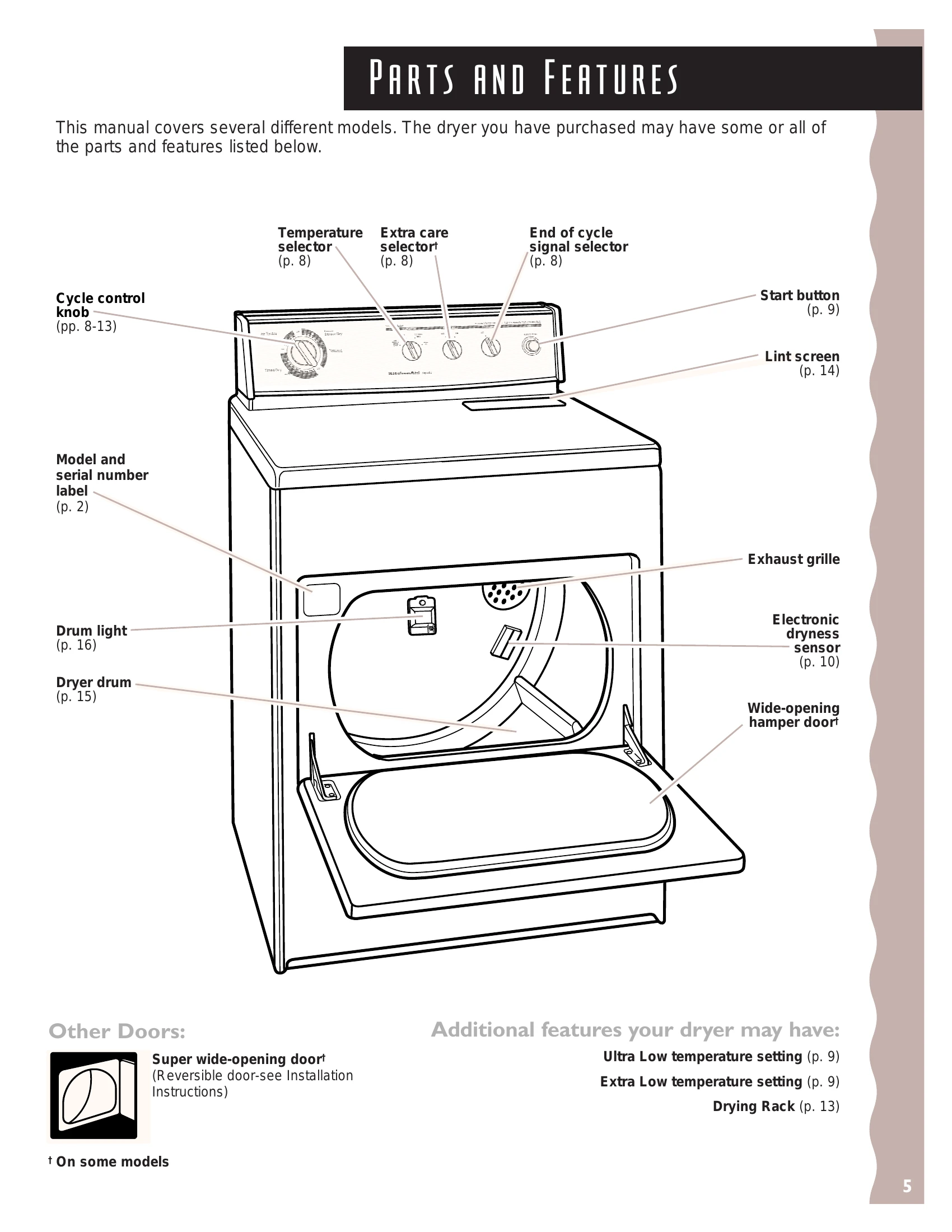
  • Turn the Cycle Control knob to the recommended cycle.
  • Set the Temperature selector.
  • Optional: Set End of Cycle Signal and Extra Care features.
  • Push the Start button.

Selecting the Right Cycle and Temperature:

  • Use Automatic (Sensor Dry) for most loads.
  • Consider Ultra Low or Extra Low settings for delicates.
  • Choose the lowest setting if multiple options are available.
  • The last few minutes of cycles are cool-down.

Drying Tips:

  • Select correct cycle/temp.
  • Follow care labels.
  • Use dryer-safe fabric softener sheets.
  • Remove load promptly to reduce wrinkling.

Troubleshooting and error codes

Problem... Cause...
Slow drying or clothes still wet
  • Incorrect cycle or temperature setting selected.
  • Full or clogged lint screen. (See page 14.)
  • Exhaust vent clogged, restricted, or too long. (See pages 6-7 and Installation Instructions.)
  • Dryer is not level. The clothes are not contacting the electronic dryness sensor. (See page 10 and Installation Instructions.)
  • Dryer located in room with temperature below 7°C (45°F).
  • Load too large and bulky to dry quickly.
  • Drying heavy fabrics (denim, towels) with light fabrics (synthetics, permanent press).
  • Fabric softener sheet blocking exhaust grille inside dryer drum.
Lint
  • Full lint screen. (See page 14.)
  • Load not properly sorted.
  • Overdrying, especially synthetic fabrics that cause lint-attracting static electricity.
  • Load size too big or heavy.
  • Tissue or paper left in pockets.
  • Pilling (surface fuzz caused by normal wear and laundering) attracts lint.
Static electricity
  • Overdrying.
  • Dryer fabric softener improperly used. See package directions.
  • Load includes synthetics, synthetic blends, permanent press, and knit fabrics that build up static electricity.
Wrinkling
  • Overloading.
  • Overdrying, especially permanent press and synthetic fabrics.
  • Large items balling or rolling up.
  • Clothes left in dryer at end of cycle.
Shrinking
  • Overdrying.
  • Fabric or garment is not designed for tumble drying.
  • Dryer settings incorrect for fabric type.
  • Care label directions not followed.
Greasy spots/stains
  • Dryer fabric softener improperly used. Do not add to a warm load.
  • Drying soiled items.
Colour change
  • Drying dark colours with light colours.
  • Drying colourfast colours with noncolourfast colours.
Garment damage
  • Zippers, snaps, and hooks left open.
  • Strings and sashes not tied to prevent tangling.
  • Care label directions not followed.
Problem... Cause...
I. Dryer will not start.
  • Is the dryer door firmly closed?
  • Are the controls set in an On position?
  • Avez-vous poussé fermement le bouton de mise en marche?
  • Le cordon de courant électrique est-il branché?
  • Avez-vous un fusible grillé ou le coupe-circuit est-il ouvert? Les sécheuses électriques emploient 2 fusibles ou coupe-circuit.
2. Lint accumulation in hood or exhaust vent, or extended drying times.
  • Le panier d'accumulation de charpie est-il plein?
  • Le conduit d'évacuation ou la hotte d'évacuation à l'extérieur sont-ils obstrués de charpie? Voir la section d'évacuation aux pages 6 et 7.
3. No heat
  • Pour les sécheuses à gaz, les soupapes sont-elles ouvertes sur le conduit d'alimentation? Aussi, certaines sécheuses peuvent avoir une soupape interne de gaz.
  • Pour les sécheuses électriques, un fusible est-il grillé, ou un circuit ouvert? Les sécheuses électriques emploient 2 fusibles ou coupe-circuits. Le tambour rotatif peut tourner mais il n'y a pas de chaleur.
4. Noises
  • Le filtre à charpie a-t-il besoin d'être nettoyé (alerte de charpie)?
  • Si la sécheuse n'a pas été utilisée depuis quelque temps, il peut exister un bruit saccadé durant les quelques premières minutes de fonctionnement. Si le bruit continue, communiquer avec le Centre d'aide aux consommateurs.
5. Odour
  • Lors du fonctionnement de la sécheuse neuve, l'élément neuf de chauffage électrique peut dégager une odeur.
  • Des produits chimiques domestiques sont-ils attirés dans la sécheuse? Une bonne aération doit être utilisée si on peint ou teint près de la sécheuse.
  • REMARQUE : Remiser et utiliser peintures, vernis, etc. loin de votre sécheuse autant que possible.
Privacy Policy