Brand: NEC
Category: Other
Document Type: Manual
Language: EN
Brand: NEC
Category: Other
Document Type: Manual
Language: EN
Uploaded: Nov. 21, 2025, 6:29 p.m.
Manual Publish Date: 2000-10-01
No warranty information is available in the provided document.
This manual details the µPD98410 (NEASCOT-X10) LSI, an ATM switch with four UTOPIA Level2 interfaces and 24x24 switching capability. It features a shared buffer, non-blocking architecture, and a 1.2 Gbps switching capacity supported by external SRAM. Key functions include ATM Forum UNI compliance, multi-speed support, various VP/VC and multicast capacities, four QoS classes (CBR, VBR, ABR, UBR), ABR traffic control, EPD/PPD support, and a +3.3V single power source compatible with +5V TTL. It also supports JTAG for testing.
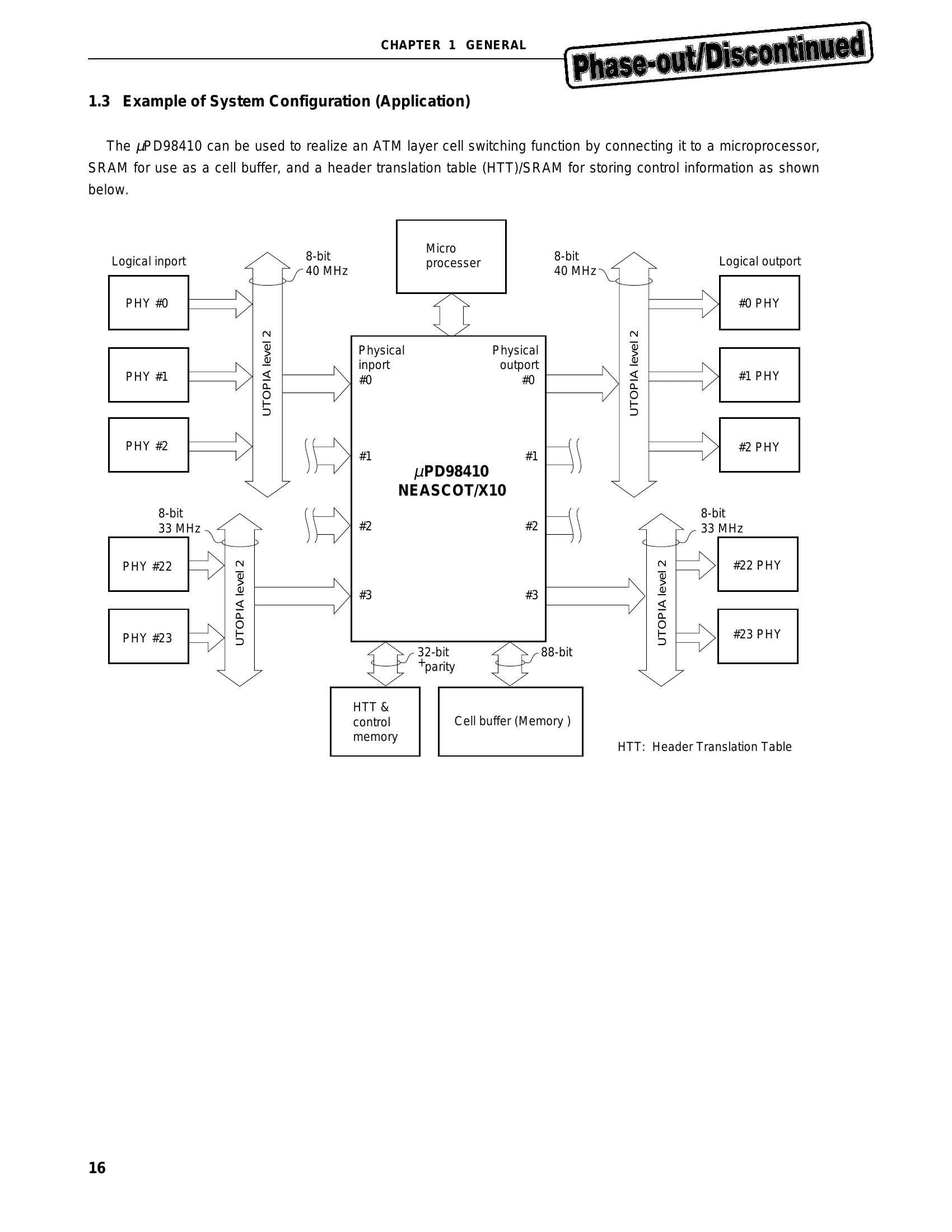
The manual covers general features, ordering information, system configuration examples, block diagrams, and pin configurations. It delves into detailed pin functions for power, UTOPIA, memory interfaces, CPU interface, JTAG, and other categories. Functional outlines describe UTOPIA interfaces, polling mechanisms, header translation, queue control, ABR congestion control, WFQ, peak rate shaping, successive transmission, interrupt requests, monitoring, and microprocessor/external memory interfaces. Internal registers are listed and described, along with JTAG boundary scan details and limitations.
| Chapter 7 FAQ (Frequently Asked Questions) | |
| Q.8 | (1) In what sequence are cells output to an actual port from the output queue of each logical output port? Are they output in a simple round-robin mode? If a cell exists in a specific queue such as the CBR queue, does that cell take precedence, or not? (2) CBR and rt-VBR are in the same output queue. How are the cells of CBR class output at constant intervals? |
| A.8 | Cells are output from an output queue in the following sequence: (a) Each PHY device is polled if it is ready for transmission. (b) A logical output port is determined based on output rate control (shaping), cell congestion information, and the result of polling. (c) A service class is determined in the determined logical output port. The service class is determined by WFQ (Weighted Fairness Queuing) method in the order of CBR + rtVBR, RM + VBR, ABR, and UBR. The output generation interval is shaping concerning ports, and WFQ concerning classes. Output of only CBR cannot be adjusted concerning the queue of CBR and rt-VBR. Because real-time feature is important for rt-VBR class as well as for CBR class, the same queue of a high priority is used. |
| Q.9 | If a cell other than valid cells, such as an idle cell or unassigned cell, is input to the input port, what is output to the output port? |
| A.9 | Because both the idle cell and unassigned cell are VPI = 0 and VCI = 0, they are output to the output port in accordance with the setting of the HTT memory. If a cell not set to the HTT memory is input, a header translation error occurs, and the input cell is discarded. |
| Q.10 | There are four multi-cast queues corresponding to each class, and the priority of a multi-cast queue is fixed during re-queuing. Does this mean that the cell of the low-order multi-cast queue is output when no cell is congested in the high-order multi-cast queue (for example, is the cell of UBR class output when no cell is congested at CBR, VBR, or ABR class)? |
| A.10 | That's right. |
| Q.11 | This is a question related to the WFQ operation. When a time out of the cycle counter occurs, are the present values of CCBR and CVBR counters and the set value of the class priority control register loaded to CCBR and CVBR counters? |
| A.11 | Yes. |
| Q.12 | Even if priority control by the CABR and CUBR counters is started, the output permission is granted to the CBR and VBR classes if there are no congested cells at ABR and UBR classes, and if there are congested cells at CBR and VBR class. In this case, is the count value decremented by the number of cells output if the CCBR and CVBR counters are not zero? |
| A.12 | Priority control by CABR and CUBR is performed in the following case: "If CCBR = 0, or no cells are congested in the CBR queue", and "if CVBR = 0, or no cells are congested in the VBR queue" In the case in the question, therefore, the output permission is granted to the CBR and VBR class only when cells are congested but the counter is 0. In this case, the counter remains 0 even if the cell has been output. |