Brand: Panasonic
Category: Tablet Computer
Document Type: Manual
Language: EN
Brand: Panasonic
Category: Tablet Computer
Document Type: Manual
Language: EN
Uploaded: Nov. 21, 2025, 8:48 p.m.
Manual Publish Date: null
null
| Problem | Solution |
|---|---|
| Shut Down: Cannot shut down or restart Windows. | Remove USB devices. It may take one or two minutes to shut down. |
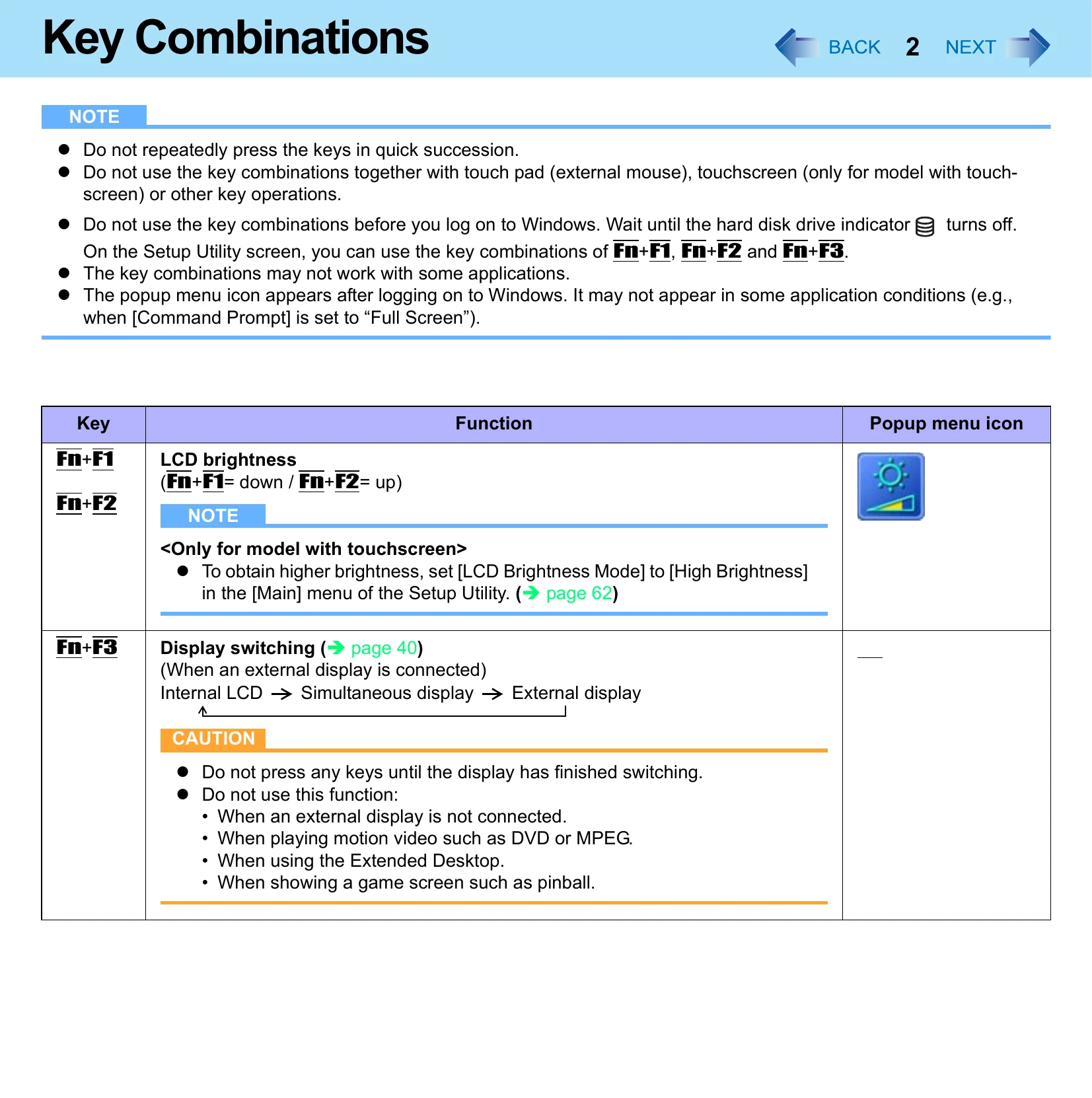
| Display: The screen does not become bright even if pressing Fn+F2. | The brightness is set low to avoid malfunction where surrounding temperature is high. Use it in an environment of between 5°C and 35°C. |
| Standby or Hibernation: Cannot enter standby or hibernation. | Remove USB devices temporarily. If the problem persists, restart the computer. It may take one or two minutes to enter standby or hibernation. The computer may not enter standby when the computer is communicating via modem. The computer does not enter standby or hibernation immediately after resuming. Wait approximately one minute. |
| Standby or Hibernation: Cannot enter standby or hibernation automatically. | Disconnect peripheral devices. If you connect to a network using wireless LAN function, select the profile and connect to the access point (→ page 54). If you do not use wireless LAN function, turn off wireless LAN function (→ page 49). Make sure that you are not using any software that regularly accesses the hard disk. |
| Standby or Hibernation: The computer does not resume. | If you slide and hold the power switch for four seconds or longer, the power will be turned off forcibly and the computer will not resume. In this case, all unsaved data will be lost. You disconnected the AC adaptor and the battery pack while the computer was in standby mode. If the computer's power supply is disconnected in standby mode, unsaved data will be lost and the computer will not resume. The battery is exhausted. Standby and hibernation consume some power. |
| Sound: No sound. | Press Fn+F4 or Fn+F6 to cancel mute. Restart the computer. |
| Sound: Distorted sound. | Performing Fn key combinations sometimes causes sound distortion. Stop and restart playback. |
| Sound: Cannot change the volume by pressing Fn+F5 or Fn+F6. | Activate the Windows sound function. When it is not active, the volume does not change even if is displayed. |
| Sound: “There was an error updating the registry” appears when Sound Recorder is started. | Sound Recorder is started by a limited account user whose language setting is not the same as the administrator user who last started Sound Recorder. This does not affect the operation. |
| Keyboard: Only numbers can be input. | When the indicator is on, the keyboard is in ten-key mode. Press NumLk to cancel. |
| Keyboard: Only capital letters can be input. | When the indicator is on, the keyboard is in Caps Lock mode. Press Caps Lock to cancel. |
| Keyboard: Cannot enter special characters (ß, à, ç, etc.) and symbols. | Use the character map. Click [start] - [All Programs] - [Accessories] - [System Tools] - [Character Map]. |
| Network: Cannot connect to network. | Set [LAN], or [LAN] and [Modem] to [Enable] in the [Advanced] menu of the Setup Utility (→ page 65). |
| Network: Cannot check the computer's MAC address. | Follow the steps below. ①Click [start] - [All Programs] - [Accessories] - [Command Prompt]. ② Input [ipconfig/all], and press Enter. Write down the 12-digit string of alphanumeric displayed in the “Physical Address" line of the LAN or the wireless LAN (only for model with wireless LAN). ④ Input [exit], and press Enter. |
| Wireless Communication: Cannot connect to network. | Slide the wireless switch to turn on the wireless devices. Set the devices ([Wireless LAN] / [Bluetooth] / [Wireless WAN]) to [Enable] in the [Advanced] menu of the Setup Utility (→ page 65). Disable the Wireless Connection Disable Utility. Restart the computer. |
| Wireless Communication: Access point is not detected. | Confirm that / / is displayed on the notification area. If / communication page 49). is not displayed on the notification area, turn on the wireless |
| Connecting Peripherals: An error occurs while installing the driver. | When you install a driver of card or peripheral device, make sure that the driver is compatible with the operating system. If it is not compatible, malfunction may occur. For information about the driver, contact the manufacturer of the peripheral device. Before connecting peripheral equipment, first determine the media that contains the peripheral device's driver (e.g., CD-ROM), then attach the device for that media to the multimedia pocket. Once the installation screen for the device's driver appears, equipment you then connect to the multimedia pocket will not be recognized. |
| Connecting Peripherals: A peripheral device does not work. | Install the driver. Contact the manufacturer of the device. When operation resumes from standby or hibernation, devices such as a mouse, modem and PC Card may not function properly. In this case, restart the computer or reinitialize the device. When ! is displayed in the Device Manager, remove and insert the device. If the problem persists, restart the computer. The computer may not recognize the connection/removal of some devices, or may not operate normally with some devices. ①Click [start] - [Control Panel] - [Performance and Maintenance] - [System] - [Hardware] - [Device Manager]. ② Select the device and remove the check mark for [Allow the computer to turn off this device to save power.] in [Power Management]. (This item may be unavailable for some types of devices.) |
| Connecting Peripherals: The connected mouse does not work. | Check the mouse connection. Install the driver compatible with the connected mouse. If the mouse does not work even after installing the driver, set [Touch Pad] to [Disable] in the [Main] menu of the Setup Utility (→ page 62). |
| Connecting Peripherals: USB floppy disk drive does not work as a boot drive. | You can use only the Panasonic CF-VFDU03U USB floppy disk drive (optional). Connect the floppy disk drive directly to a USB port of the computer. Do not connect it via a USB hub or USB connector of the port replicator. If you have connected to a USB port on the computer, try connecting it to one of the other USB ports. Set [USB Port] and [Legacy USB Support] to [Enable] in the [Advanced] menu of the Setup Utility (→ page 65). Move up [USB FDD] to the top of [Boot priority order] in the [Boot] menu of the Setup Utility (→ page 67). Turn off the computer and connect the USB floppy disk drive, and then restart the computer. |
| Connecting Peripherals: The RAM module is not recognized. | Insert the RAM module correctly. Use the compatible RAM module (→ page 34). Check the [Information] menu in the Setup Utility (→ page 61). If the RAM module is not recognized, turn off the computer and reinsert the RAM module. |
| Connecting Peripherals: You do not know the address map for IRQ, I/O port address, etc. | To check the current address map, click [start] - [Control Panel] - [Performance and Maintenance] - [System] - [Hardware] - [Device Manager] - [View] - [Resources by type]. |
| Connecting Peripherals: The device connected to the serial port does not work. | Check the connection. The device driver may not work. Refer to the instruction manual of the device. Do not connect two mouse devices simultaneously. Set [Touch Pad] to [Disable] in the [Main] menu of the Setup Utility (→ page 62). Set [Serial Port A] or [Serial Port B] to [Auto] in the sub-menu of [Serial and Parallel Port Settings] in the [Advanced] menu of the Setup Utility (→ page 63). The I/O and IRQ you can use vary depending on the device. If the setting does not work, try other settings in the Setup Utility. |
| Connecting Peripherals: The Serial Port B of the port replicator does not work. | Set [Serial Port B] to [Auto] in the sub-menu of [Serial and Parallel Port Settings] in the [Advanced] menu of the Setup Utility (→ page 63). |
| Connecting Peripherals: Cannot print. | Check the printer connection. Turn on the printer. The printer is not online. No paper is in the printer tray or there is a paper jam. Turn on the printer and connect it to the computer, and then restart the computer. |
| Connecting Peripherals: LAN transmission speed slows down noticeably. Poor performance during data transmission via a PC Card (e.g., distorted video image when writing to a DV camera using an IEEE1394 PC Card). <Only for model with wireless LAN> Wireless LAN connection is cut. | These problems may occur due to performance loss that results from the CPU power-saving function. Log on to Windows as an administrator and follow the steps below. ①Click [start] - [Run] and input [c:\util\cpupower\setup.exe], and click [OK]. Follow the on-screen instructions. ② Click [start] - [All Programs] - [Panasonic] - [CPU Idle Setting]. ③ Click [Performance] and click [OK], then click [Yes]. The computer will restart. • If the problem persists, click [start] - [Control Panel] - [Performance and Maintenance] - [Power Options] - [Power Schemes], select [Always On] in [Power schemes], and click [OK]. • The above remedy is effective for performance loss resulting from the CPU power saving function, but not for other causes (e.g., noise generated by high CPU load such as video playback). • The above remedy slightly reduces the battery operation time. Normally it is recommended to select [Battery (Windows XP Standard)] in [CPU Idle Setting] and to select [Portable/Laptop] in [Power schemes]. |
| Touch Pad / Touchscreen: The cursor does not work. | Connect the external mouse correctly. Restart the computer using the keyboard. (Press , and R to select [Restart].) • If the computer does not respond to keyboard commands, read “No response” (→ page 81). |
| Touch Pad / Touchscreen: Cannot input using the touch pad. | Set [Touch Pad] to [Enable] in the [Main] menu of the Setup Utility (→ page 62). The touch pad may be disabled by some mouse drivers. Check your mouse's operating instructions. |
| Touch Pad / Touchscreen: Cannot point the correct position using the included stylus. | Perform the touchscreen calibration (→ page 5). |
| PC Card / ExpressCard: A card does not work. | Insert the card correctly. The card does not conform to the card standard. Restart the computer after installing a driver (of card or other device). Set [PC Card Slot] and [ExpressCard Slot] to [Enable] in the [Advanced] menu of the Setup Utility (→ page 65). The port settings are not correct. Read the instruction manual of the card or contact the manufacturer of the card. Remove the card and insert it again (→ page 24). The driver is not compatible with the operating system. |
| SD Memory Card: Cannot use an SD Memory Card. | Set [SD Slot] to [Enable] in the [Advanced] menu of the Setup Utility (→ page 65). |
| SD Memory Card: Cannot use SD security function. | Setup the SD Memory Card (→ page 29). |
| SD Memory Card: Cannot log on using the SD Memory Card. | The user name and password set in the SD Memory Card are not correct. Enter the correct user name and password, and log on to Windows without using the SD Memory Card. Set the correct user name and password in [SD Card Setup] (→ page 29). |
| Smart Card: Cannot use a Smart card. | Insert the Smart card correctly. Set [Smart card] to [Auto] in the sub-menu of [Serial and Parallel Port Settings] in the [Advanced] menu of the Setup Utility (→ page 63). To use a Smart card, you need a special software and driver. |
| Fast User Switching Function: Some applications do not work properly. | When switching to a different user with the Fast User Switching function, the following problems may occur. • Some applications may not work properly. • Key combination with Fn may not work. • The display settings may not be possible. • A serial mouse may not work. <Only for model with wireless LAN> Wireless LAN cannot be used. <Only for model with Bluetooth> Bluetooth cannot be used. In these cases, log off all users without using Fast User Switching function and perform the operation once more. If the problem persists, restart the computer. |
| Others: No response. | Press Ctrl+Shift+Esc to open Task Manager and close the software application. An input screen (e.g., password input screen at startup) may be hidden behind another window. Use Alt+Tab to check. Shut down by sliding and holding the power switch for four seconds or longer, and turn on the computer and open the application again. If it no longer works normally, delete and reinstall it. Click [start] - [Control Panel] - [Add or Remove Programs]. |