Brand: SAMSUNG
Category: Microwave Oven
Document Type: Manual
Language: EN
Brand: SAMSUNG
Category: Microwave Oven
Document Type: Manual
Language: EN
Uploaded: Nov. 21, 2025, 6:36 p.m.
One (1) Year Parts and Labor, Ten (10) Years Magnetron Part (Part Only).
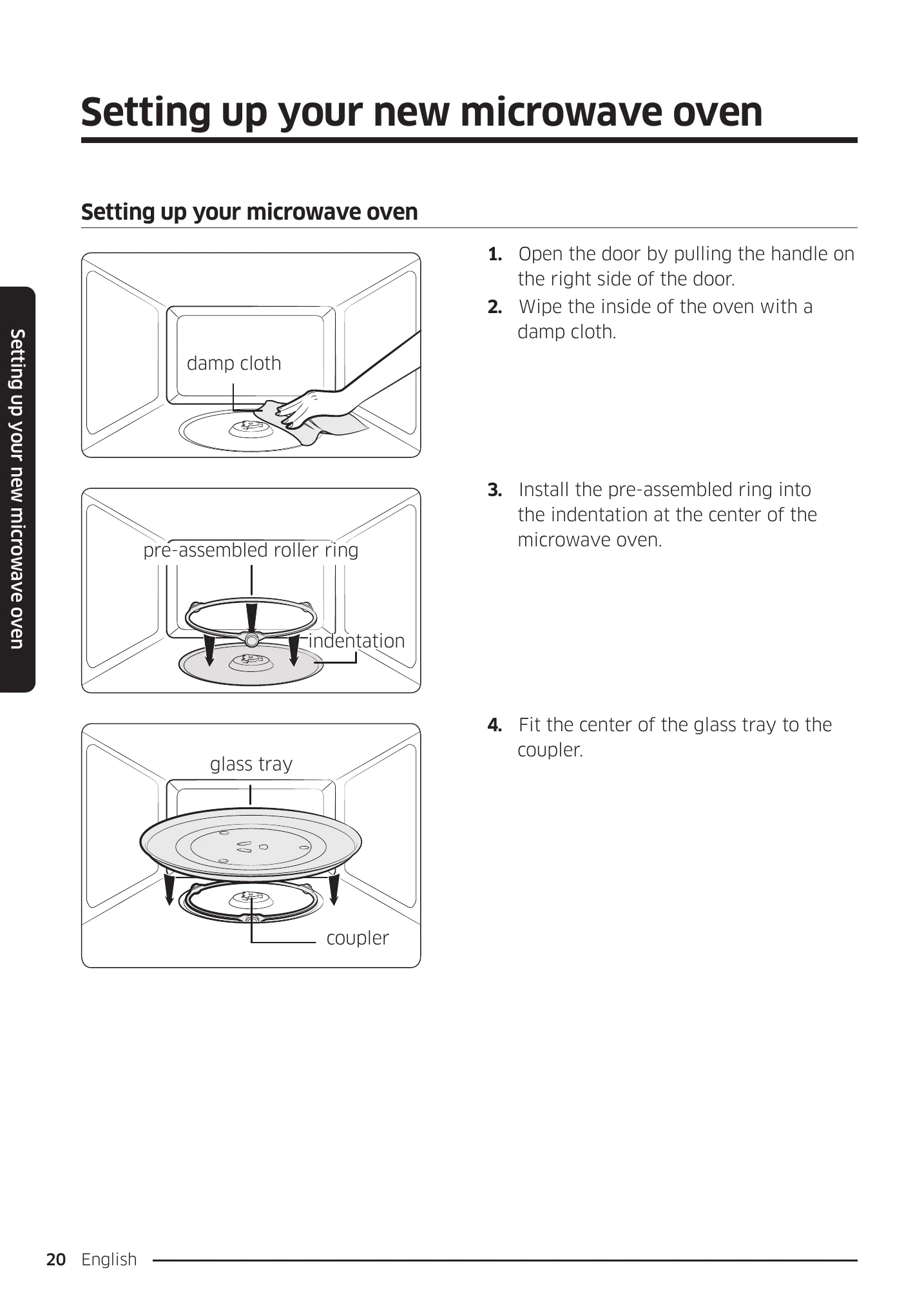
Setting up your new microwave oven
| Problem | Cause | Action |
|---|---|---|
| General | ||
| The buttons cannot be touched properly. | Foreign matter may be caught between the buttons. | Remove the foreign matter and try again. |
| For touch models: Moisture is on the exterior. | Wipe the moisture from the exterior. | |
| The time is not displayed. | Child Lock is activated. | Deactivate Child Lock. |
| Power is not supplied. | Make sure power is supplied. Confirm the microwave is plugged in. Check your fuses or circuit breakers. | |
| The oven does not work. | The Eco (power-saving) function is set. | Turn off the Eco function. |
| Power is not supplied. | Make sure power is supplied. Confirm the microwave is plugged in. Check your fuses or circuit breakers. | |
| The oven stops while in operation. | The door is open. | Close the door and try again. |
| The door open safety mechanisms are covered by foreign matter. | Remove the foreign matter and try again. | |
| The user has opened the door to turn food over. | After turning the food over, touch the START button again to start operation. | |
| The power turns off during operation. | The oven has been cooking for an extended period of time. | After the oven has cooked for an extended period of time, let the oven cool. |
| The cooling fan is not working. | Listen for the sound of the cooling fan. | |
| Trying to operate the oven without food inside. | Put food in the oven. | |
| There is not enough ventilation space around the oven. | There are intake/exhaust outlets on the front and rear of the oven for ventilation. Check the installation guide and make sure that the microwave is far enough away from walls and cabinets for proper ventilation. | |
| Several appliances or devices are plugged into the same outlet. | Unplug all other appliances or devices from the outlet. | |
| There is no power to the oven. | Power is not supplied. | Make sure power is supplied. Confirm the microwave is plugged in. Check your fuses or circuit breakers. |
| There is a popping sound during operation. | Cooking food in a sealed container or using a container with a tight lid may cause popping sounds. | Do not cook food in sealed containers or in containers with tight lids. Expanding steam from the cooking food can cause the containers to burst or the lids to pop off. |
| The oven exterior gets too hot during operation. | There is not enough ventilation space around the oven. | There are intake/exhaust outlets on the front and rear of the oven for ventilation. Check the installation guide and make sure that the microwave is far enough away from walls and cabinets for proper ventilation. |
| Objects are on top of the oven. | Remove all objects on the top of the oven. | |
| The door cannot be opened properly. | Food residue is stuck between the door and oven interior. | Clean the oven and then open the door. |
| The oven does not heat. | The oven may not work if too much food is being cooked or improper cookware is being used. | To test the oven, put one cup of water in a microwave-safe container, put the container in the oven, and then run the microwave for 1-2 minutes to check whether the water is heated. If the water is heated, reduce the amount of food and start the function again. Use a cooking container with a flat bottom. |
| Heating is weak or slow. | The oven may not work if too much food is being cooked or improper cookware is being used. | To test the oven, put one cup of water in a microwave-safe container, put the container in the oven, and then run the microwave for 1-2 minutes to check whether the water is heated. If the water is heated, reduce the amount of food and start the function again. Use a cooking container with a flat bottom. |
| The warm function does not work. | The oven may not work if too much food is being warmed or improper cookware is being used. | To test the oven, put one cup of water in a microwave-safe container, put the container in the oven, and then run the microwave for 1-2 minutes to check whether the water is heated. If the water is heated, reduce the amount of food and start the function again. Use a cooking container with a flat bottom. |
| The thaw function does not work. | The oven may not work if too much food is being thawed or improper cookware is being used. | To test the oven, put one cup of water in a microwave-safe container, put the container in the oven, and then run the microwave for 1-2 minutes to check whether the water is heated. If the water is heated, reduce the amount of food and start the function again. Use a cooking container with a flat bottom. |
| The interior light is dim or does not turn on. | The door has been left open for a long time. | The interior light may automatically turn off when the Eco function operates. |
| The interior light is covered by foreign matter. | Close and reopen the door or touch the STOP/CLEAR Eco button. Clean the inside of the oven and check again. | |
| A beeping sound occurs during cooking. | If the Auto Cook function is being used, this beeping sound means it's time to flip the food. | After turning over the food, touch the START button again to restart operation. |
| The oven is not level. | The oven is installed on an uneven surface. | Make sure the oven is installed on flat, stable surface. |
| There are sparks during cooking. | Metal containers are used during cooking or thawing. | Do not use metal containers. |
| When power is connected, the oven immediately starts to work. | The door is not properly closed. | Close the door and check again. |
| There is electricity coming from the oven. | The power source or power outlet is not properly grounded. | Make sure the power source and power outlet are properly grounded. |
| There is water dripping. | Water or steam may be generated by the cooking or defrosting process, depending on the food. This is not an oven malfunction. | Let the oven cool and then wipe with a dry dish towel. |
| There is steam through a crack in the door. | Water or steam may be generated by the cooking or defrosting process, depending on the food. This is not an oven malfunction. | Let the oven cool and then wipe with a dry dish towel. |
| There is water left in the oven. | Water or steam may be generated by the cooking or defrosting process, depending on the food. This is not an oven malfunction. | Let the oven cool and then wipe with a dry dish towel. |
| The brightness inside the oven varies. | Brightness changes depending on power output changes according to function. | Power output changes during cooking are not malfunctions. This is not an oven malfunction. |
| Cooking is finished, but the cooling fan is still running. | To ventilate the oven, the cooling fan continues to run for about 3 minutes after cooking is complete. | This is not an oven malfunction. |
| Touching the START button operates the oven. | This happens when the oven was not operating. | The microwave oven is designed to start operating when you touch the START button if it was not operating. |
| Turntable | ||
| While turning, the turntable comes out of place or stops turning. | There is no roller ring, or the roller ring is not properly in place. | Install the roller ring and then try again. |
| The turn table drags while turning. | The roller ring is not properly in place, there is too much food, or the container is too large and touches the inside of the microwave. | Adjust the amount of food. Do not use containers that are too large. |
| The turn table rattles while turning and is noisy. | Food residue is stuck to the bottom of the oven. | Remove any food residue stuck to the bottom of the oven. |
| Grill | ||
| Smoke comes out during operation. | During initial operation, smoke may come from the heating elements when you first use the oven. | This is not a malfunction. After you run the oven 2-3 times, it should stop. |
| Food is on the heating elements. | Let the oven cool and then remove the food from the heating elements. | |
| Food is too close to the grill. | Put the food a suitable distance away while cooking. | |
| Food is not properly prepared and/ / or arranged. | Make sure food is properly prepared and arranged. | |
| Oven | ||
| The oven does not heat. | The door is open. | Close the door and try again. |
| Smoke comes out during preheating. | During initial operation, smoke may come from the heating elements when you first use the oven. | This is not a malfunction. After you run the oven 2-3 times, it should stop. |
| Food is on the heating elements. | Let the oven cool and then remove the food from the heating elements. | |
| There is a burning smell or a burnt plastic smell when using the oven. | Plastic or non-heat resistant cookware is used. | Use glass cookware suitable for high temperatures. |
| There is a bad smell coming from inside the oven. | Food residue or plastic has melted and stuck to the interior. | Use the steam function and then wipe the interior of the microwave with a dry cloth. You can put a measuring cup containing a cup of water and a lemon slice inside and run the oven to remove the odor more quickly. |
| The oven does not cook properly. | The oven door is frequently opened during cooking. | Do not open the door frequently unless you are cooking things that need to be turned. If you open the door often, the interior temperature will be lowered and this may affect the results of your cooking. |
| The oven controls are not correctly set. | Set the oven controls correctly and try again. | |
| The grill or other accessories are not correctly inserted. | Insert the accessories correctly. | |
| The wrong type or size of cookware is used. | Reset the oven controls or use suitable cookware with flat bottoms. |