Manual for SJ-BB04DTXW1-EU

Manual for SJ-BB04DTXW1-EU

Brand: SHARP

Category: Home Appliances

Document Type: Manual

Language: EN
Uploaded: Nov. 21, 2025, 8:50 p.m.

Warranty Information

Refer to the manual for important safety information on installation, safety, use, and maintenance of your Fridge Freezer.

Using Your Fridge Freezer

General Warnings:

  • Ensure ventilation openings are clear.
  • Do not use mechanical devices for defrosting.
  • Do not use other electrical appliances inside the fridge.
  • Do not damage the refrigerant circuit.
  • Ensure the supply cord is not trapped or damaged.
  • Do not use multiple portable socket-outlets or power supplies at the rear.
  • Install according to manufacturer instructions.
  • The refrigerant R600a is flammable and explosive if ignited in enclosed conditions.
  • Do not store flammable materials near the fridge.
  • This appliance is intended for household and similar applications.
  • Requires a 220-240V, 50Hz mains supply.

Before Using:

  • Check for visible damage before installation.
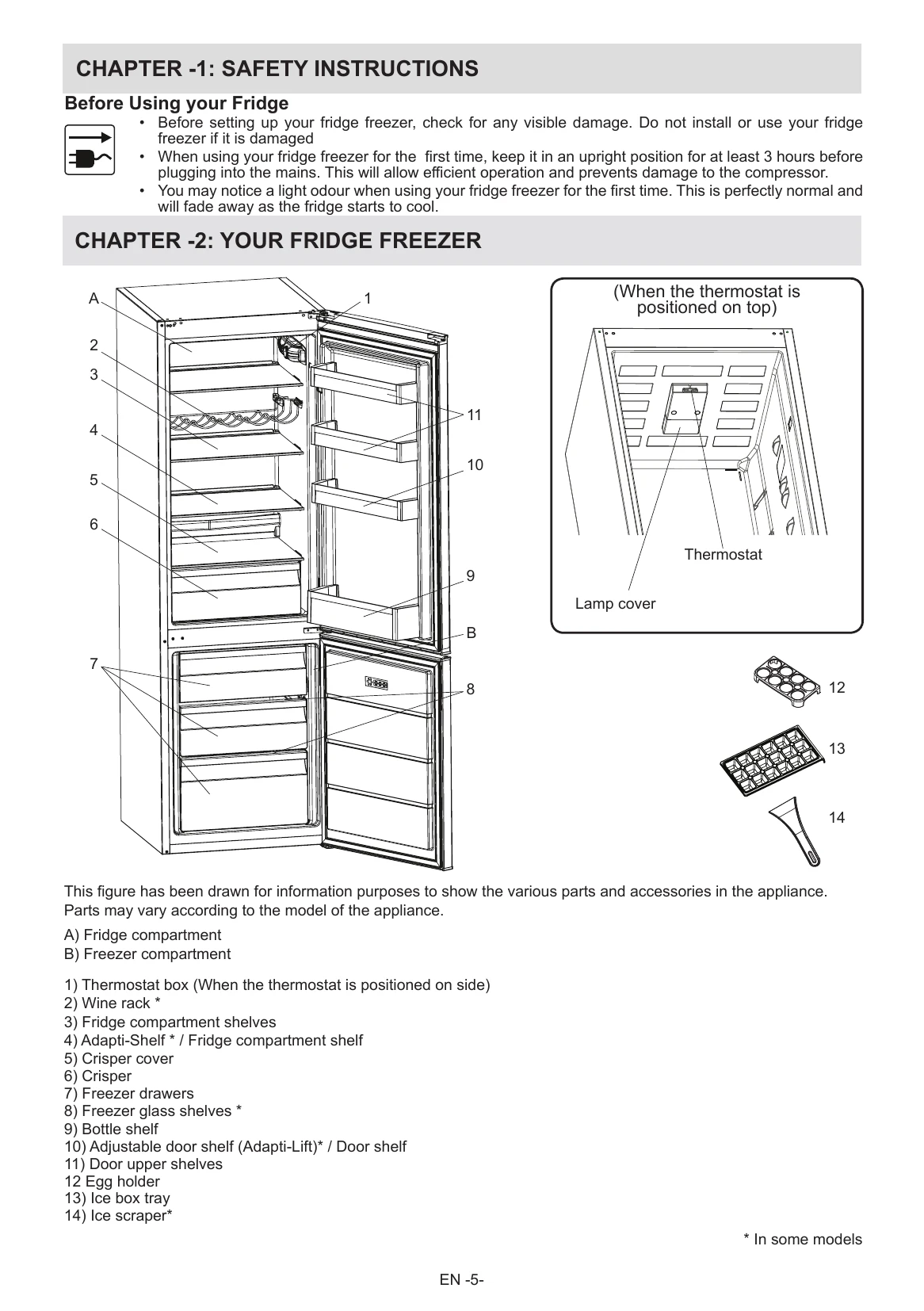
  • Keep upright for at least 3 hours before plugging in.
  • A slight odor may be noticed initially, which is normal.

Temperature Setting:

  • Thermostat knob controls temperature (1-5, 5 being coldest).
  • For short-term freezer storage, use 1-3. For long-term, use 3-4.
  • Consider ambient temperature, food freshness, and door opening frequency.
  • Avoid operating below 10°C.
  • Leave the fridge running for 24 hours before loading food.
  • Features a 5-minute built-in delay for compressor protection.
  • Operates within specific climate class temperature intervals (e.g., 16°C - 38°C for SN).
  • Use the temperature indicator to ensure optimal storage.

Food Storage:

  • Store liquids in sealed containers in the fridge.
  • Cool hot food before storing.
  • Do not let food touch the back wall to avoid frost buildup.
  • Coldest area is above the crisper; warmest is the top door shelf.
  • For freezing, ensure food surface contacts the cooling surface.
  • Do not place fresh food next to frozen food.
  • Portion food for easier freezing.
  • Follow package instructions for frozen food storage life.
  • Do not refreeze thawed food.

Cleaning:

  • Unplug before cleaning.
  • Do not pour water on the appliance.
  • Use a warm, soapy cloth for interior and exterior.
  • Clean shelves and drawers separately.
  • Do not use solvents or abrasive cleaners.
  • Clean the condenser at least once a year.

Defrosting:

  • Refrigerator compartment defrosts automatically.
  • Freezer compartment requires periodic defrosting when frost exceeds 5mm.
  • Use plastic scraper, not sharp metal objects.

Troubleshooting:

  • Check power supply, plug, and socket.
  • Ensure adequate space at the rear and sides.
  • Level the appliance.
  • Check drain hole for clogs if water is in the lower part.

Energy Saving Tips:

  • Allow food to cool before storing.
  • Thaw food in the fridge compartment.
  • Do not overfill the freezer beyond the load limit line.

Troubleshooting and error codes

Problem Check / Action
The appliance is not working.
  • Is there a power failure?
  • Is the plug connected correctly?
  • Is the fuse blown?
  • Is the socket working? (Try another socket)
The different compartments of the fridge do not get cold enough:
  • Has the appliance been overloaded?
  • Are the doors closed perfectly?
  • Is there dust on the condenser?
  • Is there enough space at the rear and side walls?
Your fridge freezer is too noisy.
  • The cooling gas may make a slight noise (bubbling sound) when the compressor is not running, this is normal.
  • If sounds are different, check:
    • The appliance is well levelled.
    • Nothing is touching the rear.
There is water in the lower part of the refrigerator:
  • Is the drain hole for defrost water clogged? (Use defrost drain plug to clean)
Privacy Policy