Brand: SIEMENS
Category: Dishwasher
Document Type: Manual
Language: EN
Brand: SIEMENS
Category: Dishwasher
Document Type: Manual
Language: EN
Uploaded: Nov. 21, 2025, 6:45 p.m.
Manual Publish Date: 2012-01-30
Warranty information is not explicitly provided in this section of the manual.
Safety First: Always prioritize safety. Repairs should be done by qualified electricians. Disconnect power before servicing. Use residual-current-operated circuit-breakers for live testing. Wear protective gloves and observe electrostatic discharge precautions.
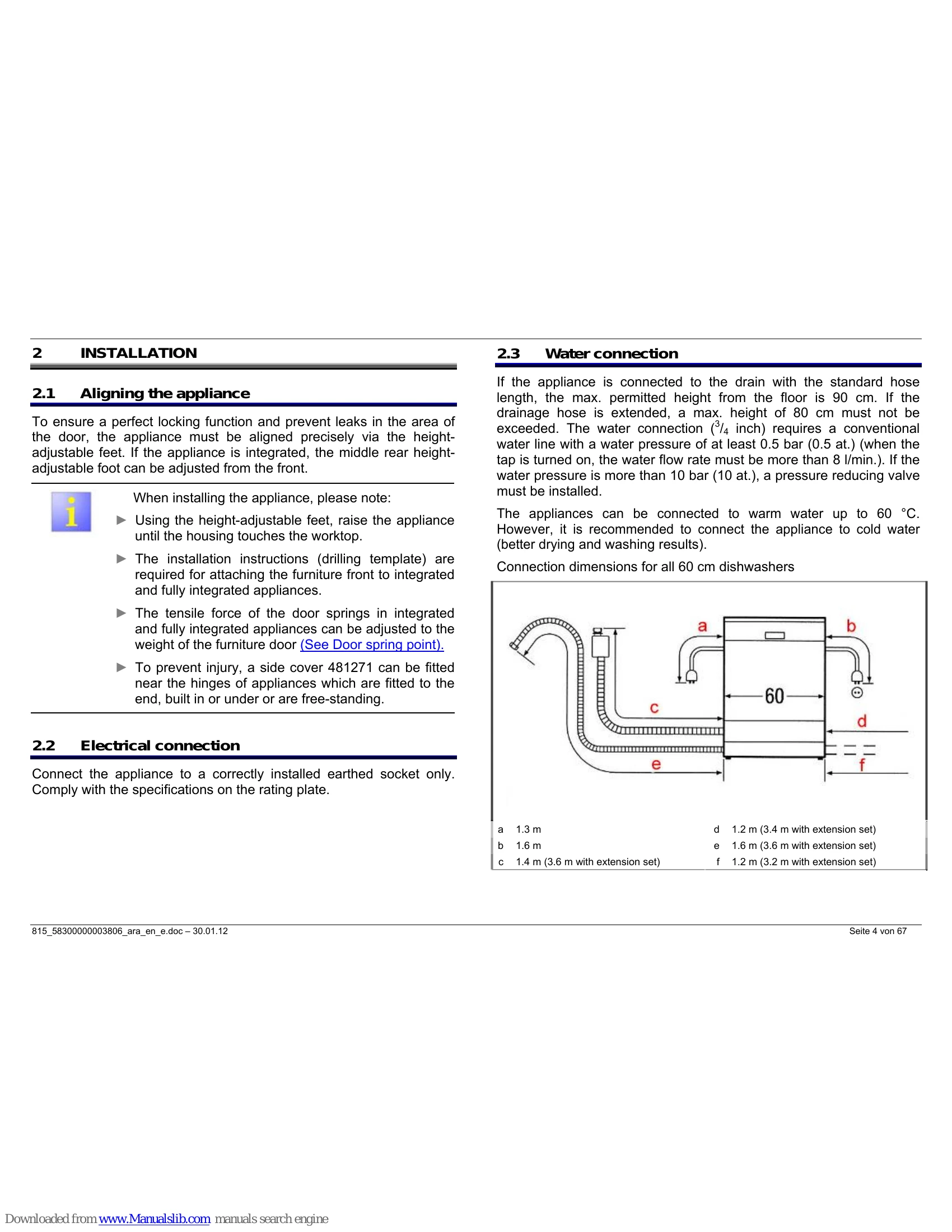
Installation: Ensure proper alignment using adjustable feet. Connect to a grounded socket. For water connection, observe hose length limits and pressure requirements (0.5-10 bar). Cold water connection is recommended for better results.
Operation: Features a digital display showing remaining time. Includes various program selection buttons (Intensive, Auto, ECO, Gentle, Quick, Prerinse) and optional additional functions like Half Load, Vario Speed, and Time Reduction. Special functions allow setting hardness range, intensive drying, and deactivating rinse-aid indicators.
Components: The manual details various components including the module, actuator, aqua sensor, Aqua Stop valve, NTC sensor, regeneration/drainage valve, raw water valve, salt/rinse-aid indicators, dispenser, instantaneous water heater, and water softening system.
Troubleshooting: Provides guidance on diagnosing and resolving issues related to rinsing results (food remnants, limescale, starch deposits, discoloration), detergent residue, and utensil damage.
| Customer complaint | Cause | Remedial action |
|---|---|---|
| Food remnants or sandy residue | Rough, micro or fine sieve blocked, sieve not locked in the pump sump | Advise customer, sieve insert and care |
| Spray arm nozzles, roof shower blocked | Clean parts if necessary, refer customers to correct sieve insert | |
| Spray arm bearings sticking (dirt around the bearings) | Clean parts if necessary, refer customers to correct sieve insert | |
| Foreign body around the drainage hose connections on the water inlet (drainage channel) | Clean | |
| Fish-trap in the pump sump partially blocked | Advise customer, clean | |
| Drainage hose kinked | Lay drainage hose correctly | |
| No detergent dosage or insufficient dosage, wrong programme selected | Advise customer, observe dosage instructions for the detergent, select programme with higher temperature Check dispenser |
|
| Food remnants or sandy residue | Unfavourable arrangement of the dishes, etc. (very large pieces in the lower rack, e.g. pots), avoid holders, dish racks twisted | Advise customer, straighten dish racks (see instructions for use) |
| Spray arm is blocked by dishes or cutlery | Advise customer | |
| Food remnants or sandy residue | Snorkel noises; circulation pump does not run uniformly, insufficient water in the appliance (note: intervals approx. 1 min if using alternate rinsing technology) | Check level sensor function (implement filling process) |
| Non-return valve leaking, dirty water flows back into the appliance | Remove non-return valve, check valve and seat for dirt and, if required, clean. | |
| Appliance does not circulate water | Check circulation pump | |
| Appliance does not heat up | Check heating circuit according to circuit diagrams, note pressure switch on the instantaneous water heater (the circulation pump cannot build up adequate pressure if there is insufficient water in the appliance). | |
| in the top basket | Only bottom basket is rinsed | Blockage in the rinse cycle of the top basket; please note that rinsing takes place only in the bottom basket in some programme sections. Please use the customer service test programme and diagnosis aid for testing. |
| in bottom basket | Washing takes place in top basket only. If appliances feature a top basket valve in production period FD 7809 to FD 7811, the float of the top basket valve may stick between instantaneous water heater and pump sump. | Replace instantaneous water heater. |
| Limescale on the utensils | Hardness range incorrectly set or untreated water hardness > 50 °dH, check residual hardness in the wash and final rinse cycles | Adjusting hardness range |
| Does not regenerate | Adjust regeneration position and conduct performance test (observe drainage of regeneration dispenser) Check regeneration valve carefully (mechanical - valve stem; electrical - actuation / coil) | |
| Untreated water valve does not open -> appliance is filled with untreated water only. | Check untreated water valve (mechanical - valve stem; electrical - actuation / coil) | |
| Starch deposits on the utensils | Underdosing of detergent (wrong detergent) | Advise customer, use enzyme detergent |
| Wrong programme selected (too weak programme selected) | Advise customer, select correct programme | |
| Appliance connected to hot water, water inlet temperature too high | Check hot water connection (setpoint: lower than 60 °C), advise customer; if required, connect to cold water | |
| Water-soluble residue | Regeneration salt on the utensils | Advise customer, eliminate leaks |
| Leaking salt dispenser cover (check screw-fitting, regeneration dispenser is dispensing slowly) | Advise customer, eliminate leaks | |
| Leaking regeneration valve (regeneration dispenser is dispensing slowly) | Check valve and/or valve seat | |
| Regeneration valve continuously actuated | Electrical check with circuit diagrams | |
| Initial clouding of glass: can only apparently be wiped off | See Damage to utensils | |
| Detergent-solution carry-over | See Food remnants | |
| Combination product | Advise customer | |
| Colour residue | Insufficient detergent used | Advise customer, increase amount of detergent |
| Plastic discoloration by, e.g.: tomato remnants, tea, coffee, etc. | Use detergent containing chlorine bleach. Recommend machine detergent for discoloration in the appliance |
|
| Detergent very lumpy, washing effect and dissolving performance reduced | Advise customer, store detergent dry and sealed | |
| Selected programme not intensive enough (the contact time of the oxidation bleach is too brief for a short running time and at low temperatures) | Advise customer, use more intensive programme | |
| Rainbow streaks | Silicate deposits only on glasses (not to be removed) | No remedial action possible (damage to glass) |
| Silver cutlery tarnishes | Final rinse dosing set too high (can be rinsed off with water) | Reduce dosing setting |
| Discoloration due to sulphur compounds in the air and in various food remnants | Advise customer, rinse silver cutlery immediately after use | |
| Detergent residue | Detergent cover blocked by utensils (does not open fully) | Advise customer, dishwasher not loaded properly |
| Detergent cover does not open fully | Replace spring of dispensing device | |
| Wrong programme selected | Advise customer | |
| Tablets used in quick or short programme | Tablet dissolving time is too long | |
| Incorrect application of tablets (note use in dispenser or cutlery basket) | Advise customer, follow instructions for use of the tablets | |
| Spray arm nozzles blocked (filters locked) | Advise customer | |
| Dispensing device in spray shadow (large pan, etc. positioned at bottom left) | Advise customer | |
| Check draining, non-return valve | See food remnants | |
| Detergent very lumpy, washing effect and dissolving performance reduced | Advise customer | |
| Initial or already irreversible glass clouding | Hardness range set too high, residual hardness in wash cycle or final rinse < 5 °dH. | Optimise setting according to measurement. |
| Glasses not dishwasher-proof (glasses are usually only suitable for dishwasher). | Advise customer. | |
| Too intensive programme selected. | Advise customer, select a low programme for glasses (low temperature < 50 °C). | |
| Reaction time of steam in drying cycle too long. | Advise customer, do not switch on the appliance and wait a few hours before removing the utnesils; e.g. over night. | |
| Mechanical damage (scratches or breakage) | Scratches caused by contact points/surfaces with other utensils. Advise customer, avoid touching utensils when loading. |
|
| Utensils pale | Utensils not dishwasher-proof. Advise customer, use dishes that are suitable for dishwashers. |
|
| Rust on the cutlery | Cutlery corrosion: cutlery not dishwasher-proof (knife/knife blade steel is usually less resistant to corrosion). Use cutlery that is suitable for dishwashers! (higher chromium/nickel content, at least 18/8 or 18/10). |
|
| Rust film: Infection caused by corroding utensils or utensil baskets. | Advise customer, do not wash any rusting parts, e.g. old pan, in the dishwasher! | |
| Not drying correctly | No rinse aid in the dispensing device | Advise customer |
| Appliance connected to hot water, appliance is suitable for hot-water connection, but not recommended. | Advise customer, refer to function of the heat exchanger; if required, connect the appliance to cold-water supply | |
| Appliance not heating | Check heating circuit according to circuit diagrams, note pressure switch on the instantaneous water heater (the circulation pump cannot build up adequate pressure if there is insufficient water in the appliance). | |
| Programme selected without drying | Advise customer, quick programme is without drying cycle, drying level option is too low | |
| The rinse aid integrated in tablets has dissolved too early | Advise customer, tablet is unsuitable for this programme | |
| Plastic parts | Plastics retain very little heat and have a hydrophobic surface which is difficult to moisten. As a result, droplets will form during drying. |
|
| Combined detergent products (2 in 1/3 in 1) | Advise customer, recommend separate detergent products (separate rinse aid and detergent) | |
| Circulation pump does not start | After a prolonged idle time the seal set may stick to the pump wheel. | The seal set must be replaced, |