Brand: SIEMENS
Category: Dishwasher
Document Type: Manual
Language: EN
Brand: SIEMENS
Category: Dishwasher
Document Type: Manual
Language: EN
Uploaded: Nov. 21, 2025, 7:10 p.m.
Warranty information is detailed, including the Aqua-Stop guarantee for water damage protection.
Intended Use: This appliance is intended for use in home and domestic environments for washing domestic dishes, up to an altitude of 2500 meters.
Safety Instructions: Read instructions carefully. Keep children away. Ensure proper installation and electrical connection. Do not use damaged appliances. Dispose of packaging responsibly.
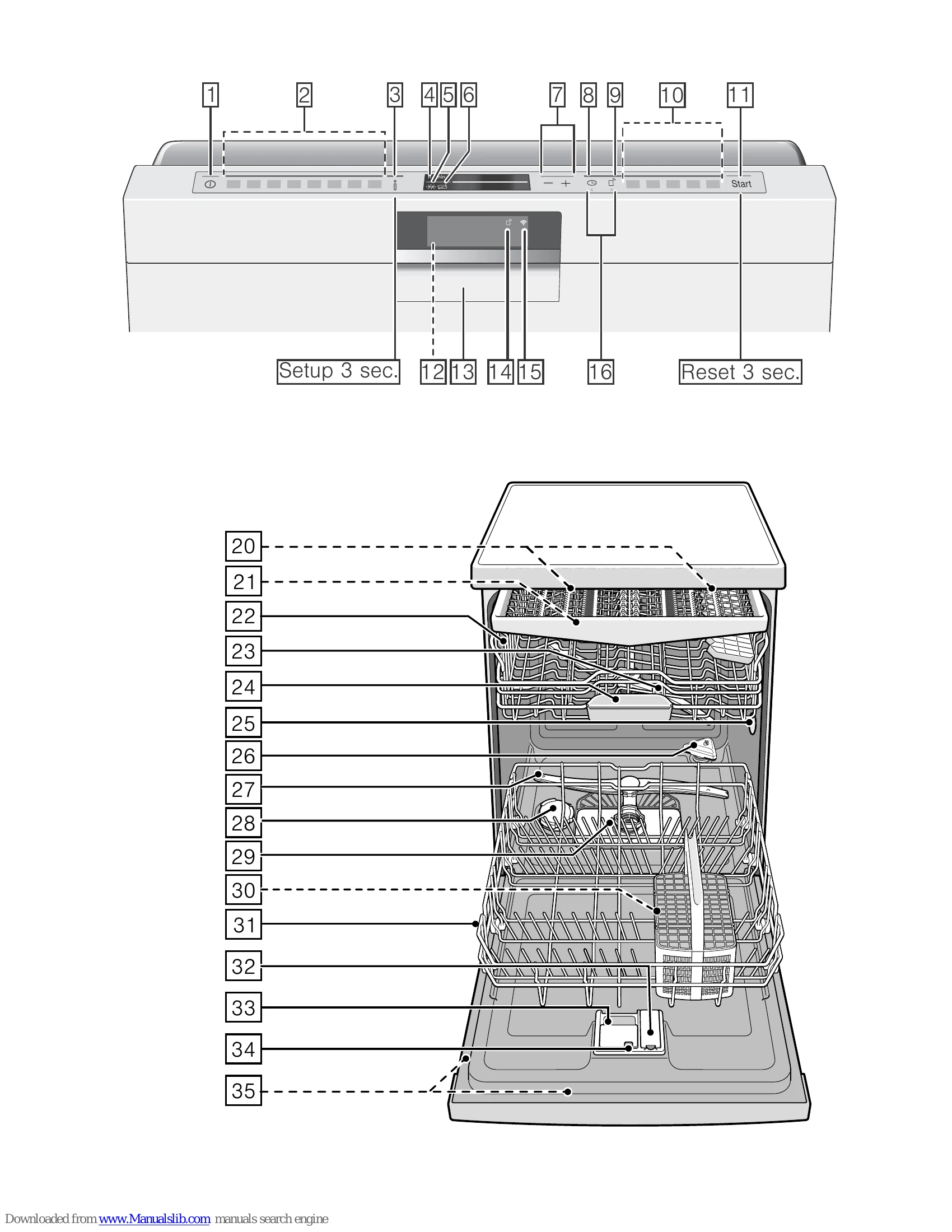
Getting to Know Your Appliance: Familiarize yourself with the control panel, appliance interior, and settings. The manual details functions like time setting, initial start-up, and Home Connect setup.
Operation: Select programmes and additional functions. Load the dishwasher correctly. Add detergent and rinse aid as needed.
| Fault | Cause | Remedial action |
|---|---|---|
| Utensils not dry. | No or too little rinse aid in the dispenser. | Refill rinse aid. |
| Programme selected without drying. | Select programme with drying. | |
| Water collecting in depressions on the utensils and cutlery. | Arrange utensils in a sloping position. | |
| Plastic utensils not dry. | The combined detergent used has a poor drying performance. | Use different combination detergent with better drying performance. Use of rinse aid also increases the drying performance. |
| ExtraDry to increase drying not activated. | Activate ExtraDry. | |
| Utensils were removed too early or drying process had not ended yet. | Wait until program ends or wait until 30 min after program ends before removing utensils. | |
| The eco rinse aid used has a limited drying performance. | Use a proprietary rinse aid. Eco products may have limited effectiveness. | |
| Special properties of plastic. | Plastic has a lower heat storage capacity and therefore dries less well. | |
| Cutlery not dry. | Cutlery not arranged properly in the cutlery basket. | Separate cutlery if possible, prevent contact points. |
| Cutlery not arranged properly in the cutlery drawer. | Arrange cutlery properly and separate if possible. | |
| Appliance interior wet after rinse cycle. | No appliance fault. | On account of the “Condensation drying” principle, water droplets are physically induced and required in the container. |
| Food remnants on the utensils. | Utensils placed too closely together, utensils basket overfilled. | Arrange utensils with adequate clearance between them ensuring that the spray jets can reach the surface of the utensils. Prevent contact points. |
| Spray arm rotation obstructed. | Arrange utensils so that the spray arm can rotate without obstruction. | |
| Spray arm nozzles are blocked. | Clean the spray arm nozzles. | |
| Filters 29 dirty. | Clean filters. | |
| Filters 29 inserted incorrectly and/or not engaged. | Insert and engage filters correctly. | |
| Rinse programme too weak. | Select a more intensive rinse programme. Increase sensitivity of the sensors. | |
| Utensils precleaned too intensely; sensors therefore decide on weak programme sequence. Stubborn soiling cannot be completely removed. | Do not prerinse utensils. Remove only large food remnants. Increase sensitivity of the sensors. Recommended programme Eco 50° or Intensive. | |
| Tall narrow receptacles in corner areas are not rinsed adequately. | Do not place hollow receptacles too obliquely and do not place in the corner area. | |
| Top basket 22 on right and left not set to same height. | Set top basket to same height using side levers. | |
| Detergent residue. | Detergent dispenser cover 33 blocked by utensils and therefore does not open fully. | Utensils must not be placed above the tablet collecting tray 24. These may block the lid of the detergent dispenser and prevent it from opening fully. |
| Detergent dispenser cover 33 blocked by the tablet. | Tablet must be inserted flat and not upright. | |
| Tablets used in the quick or short programme. Dissolving time of the detergent is not reached in the selected short programme. | Dissolving time of tablets too long for a quick or short programme. Use a detergent powder or select a more intensive programme. | |
| Washing effect and dissolving performance are reduced after a prolonged storage time or detergent is very lumpy. | Change detergent. | |
| Water stains on plastic parts. | Droplet formation on plastic surface is physically unavoidable. After drying, water stains are visible. | Use a more intensive programme (more water changes). Arrange utensils in a sloping position. Use rinse aid. If required, increase softening setting. Change detergent brand. Clean appliance mechanically. |
| Washable or water-soluble coatings in the container or on the door. | Detergent substances are deposited. These coatings cannot usually be removed with chemicals (appliance cleaner, ...). | Change detergent brand. Clean appliance mechanically. |
| If there is a “white coating” on the container floor, the water softening system has been set marginally. | Increase softening setting and change detergent if required. | |
| Salt dispenser cover 28 not closed. | Close salt dispenser cover correctly. | |
| Only for glasses: Initial glass corrosion – can only apparently be wiped off. | See “Glass and utensil damage”. | |
| White, stubborn coatings; limescale on the utensils, container or door. | Detergent substances are deposited. These coatings cannot usually be removed with chemicals (appliance cleaner, ...). | Change detergent brand. Clean appliance mechanically. |
| Hardness range incorrectly set or water hardness greater than 8.9 mmol/l. | Set water softening system according to instructions for use or top up salt. | |
| 3in1 detergent or bio/eco detergent not effective enough. | Set water softening system according to instructions for use or use separate detergents (proprietary detergent, salt, rinse aid). | |
| Underdosing of detergent. | Increase detergent dosage or change detergent. | |
| Too weak rinse programme selected. | Select a more intensive rinse programme. | |
| Too low rinsing temperature. | Select programme with higher washing temperature. | |
| Tea or lipstick residue on the utensils. | Too little or unsuitable detergent. | Use suitable detergent at correct dosage. |
| Utensils precleaned too intensely; sensors therefore decide on weak programme sequence. Stubborn soiling cannot be completely removed. | Do not prerinse utensils. Remove only large food remnants. Increase sensitivity of the sensors. Recommended programme Eco 50°. | |
| Coloured (blue, yellow, brown), difficult to remove to non-removable coatings in the appliance or on stainless steel utensils. | Film formation consisting of ingredients from vegetables (e.g. cabbage, celery, potatoes, noodles, ...) or the tap water (e.g. manganese). | Can be partly removed with machine cleaner or by mechanical cleaning. Coatings are harmless. |
| Film formation caused by metallic components on silver or aluminium utensils. | Can be partly removed with machine cleaner or by mechanical cleaning. | |
| Coloured (yellow, orange, brown), easily removable deposits inside the appliance (mainly in the floor area). | Film formation consisting of ingredients from food remnants and substances from the tap water (limescale), “soapy”. | Check function of the water softening system (refill with salt) or, if using combined detergents (tablets), activate water softening system. |
| Discolouration of the plastic parts inside the appliance. | Plastic parts inside the appliance may become discoloured during the service life of the dishwasher. | Discolouration is normal and will not impair the function of the dishwasher. |
| Plastic parts discoloured. | Too low rinsing temperature. | Select programme with higher washing temperature. |
| Utensils precleaned too intensely; sensors therefore decide on weak programme sequence. Stubborn soiling cannot be completely removed. | Do not prerinse utensils. Remove only large food remnants. Increase sensitivity of the sensors. Recommended programme Eco 50°. | |
| Removable streaks on glasses, glasses with metallic appearance and cutlery. | Too much rinse aid. | Set rinse aid amount to lower setting. |
| No rinse aid added or setting too low. | Add rinse aid and check dosage (recommended setting 4-5). | |
| Detergent residue in the final rinse programme section. Detergent dispenser cover blocked by utensils (cover does not open fully). | Detergent dispenser cover must not be obstructed by utensils. Do not place utensils or fragrance dispenser in the tablet collecting tray. | |
| Initial or existing, irreversible clouding of glass. | Utensils precleaned too intensely; sensors therefore decide on weak programme sequence. Stubborn soiling cannot be completely removed. | Do not prerinse utensils. Remove only large food remnants. Increase sensitivity of the sensors. Recommended programme Eco 50°. |
| Glasses not dishwasher-proof, only suitable for dishwasher. | Use dishwasher-proof glasses. Avoid long steam phase (standing time after wash cycle ends). Use wash cycle at lower temperature. Set water softening system according to the water hardness (if required one setting lower). Use detergent with glass protection component. | |
| Rust spots on the cutlery. | Cutlery not adequately rust-resistant. Knife blades are frequently more severely affected. | Use corrosion-resistant cutlery. |
| Cutlery will also rust if rusting parts are rinsed at the same time (pan handles, damaged utensil baskets, etc.). | Do not wash rusting parts. | |
| Salt content in the rinsing water too high, as salt dispenser lock not fastened firmly or salt was spilled while being refilled. | Fasten salt dispenser lock firmly or remove spilled salt. | |
| Appliance cannot be switched on or operated. | Malfunction. | Disconnect appliance from the power supply; pull out the mains plug or switch off the fuse. Wait at least 5 seconds, then connect the appliance to the power supply. |
| Appliance does not start. | The mains fuse has tripped. | Check mains fuse. |
| Power cord not inserted. | Ensure that the power cord is plugged all the way into the back of the appliance and into the socket. Check that the socket functions. | |
| Programme starts automatically. | The appliance door has not been shut properly. | Close the door. |
| You did not wait until programme ended. | Perform reset. | |
| The door is difficult to open. | Child-proof lock is activated. | Deactivate the child-proof lock. |
| Door cannot be closed. | Door lock has been activated. | Close door with increased force. |
| Door cannot be closed due to installation. | Check appliance installation: Door or attached parts must close without obstruction. | |
| Cover on the detergent dispenser cannot be closed. | Detergent dispenser or cover guide blocked by sticky detergent residue. | Remove detergent residue. |
| Detergent residue in the detergent dispenser 33 or in the tablet collecting tray 24. | Spray arms blocked by utensils, therefore detergent is not rinsed out. | Ensure that the spray arms can rotate freely. |
| The detergent dispenser was damp when filled. | Pour detergent into the dry detergent dispenser only. | |
| Appliance stops in the programme or programme is interrupted. | Door not closed properly. | Close the door. |
| Do not place utensils or fragrance dispenser in the tablet collecting tray. Top basket presses against the door and prevents door from being closed securely. | Check whether rear panel is being pressed in, e.g. by socket or by hose holder which has not been removed. | |
| Filling valves making striking noises. | Power and/or water supply interrupted. | Restore power and/or water supply. |
| Depends on domestic installation, as appliance is not defective. No effect on appliance function. | No remedial action possible. | |
| Knocking or rattling noise. | Spray arm strikes the utensils, utensils not positioned correctly. | Position utensils so that the spray arms do not strike the utensils. |
| If there is a low load, the water jets strike the washing tank directly. | Load the appliance with more utensils or distribute the utensils more evenly in the dishwasher. | |
| Light utensils move during the wash cycle. | Arrange light utensils securely. | Arrange light utensils securely. |
| Unusual foam formation. | Handwash liquid in the rinse aid dispenser. | Immediately refill rinse aid dispenser with rinse aid. |
| Rinse aid spilled. | Remove rinse aid with a cloth. |